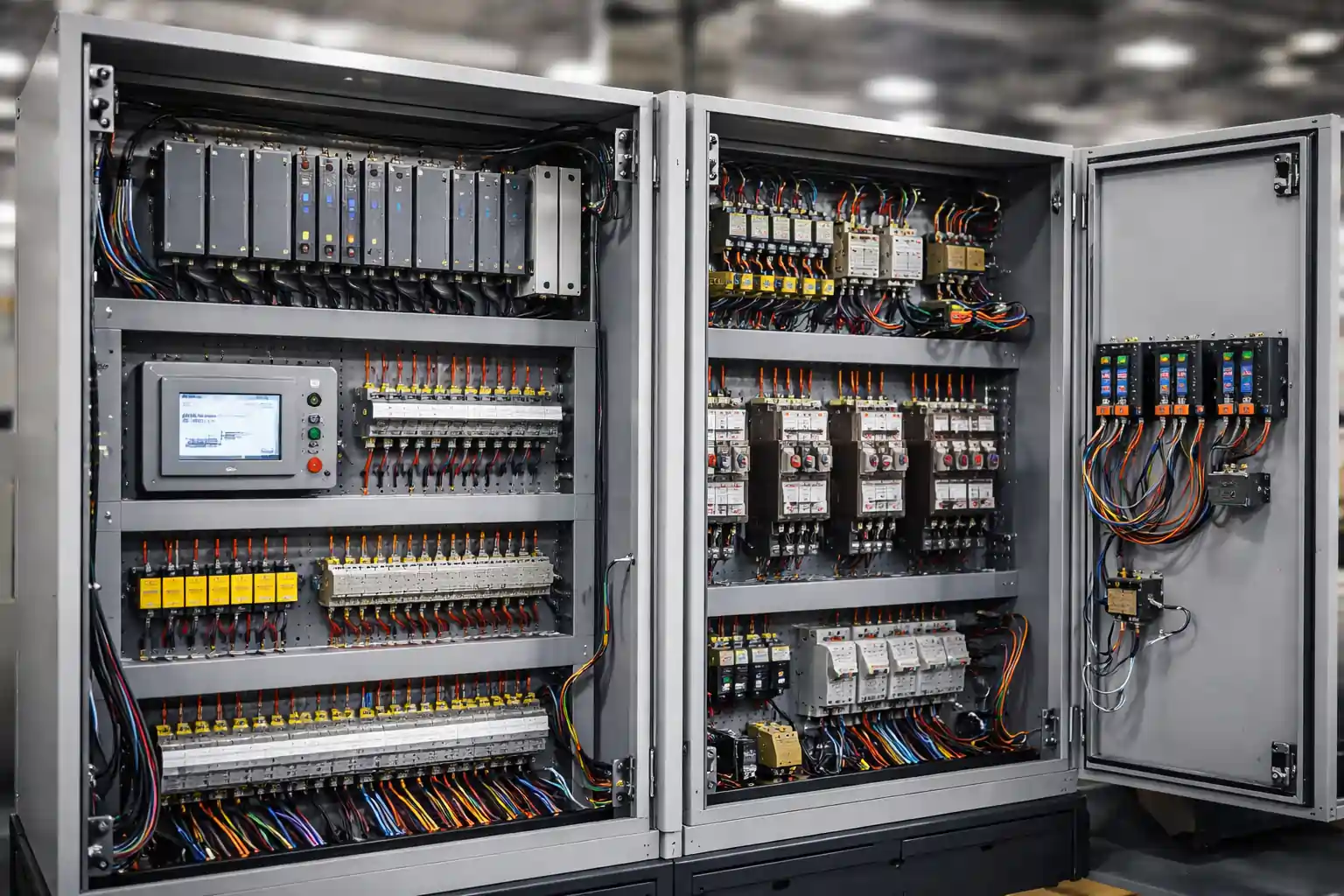
In most industrial plants, power factor problems don’t appear suddenly. At first, everything looks normal. Machines run smoothly, production is stable, and electricity bills seem acceptable. But as the load increases-more motors, more VFDs, longer operating hours-the electricity bill slowly starts showing penalties.Many industries struggle with low power factor and rising penalties. Power factor improvement using PLC and SCADA offers a reliable and intelligent solution for dynamic industrial loads.
When engineers check the panel room, they usually find capacitor banks already installed. Still, the power factor keeps fluctuating. This is the point where many plant managers ask the same question:
“If power factor correction panels are already installed, why are we still facing penalties?”
This is exactly where a SCADA and PLC based power factor control system makes a real difference.
Understanding Power Factor Problems in Industrial Plants
In industrial environments, power factor issues mainly occur because of inductive loads. Motors, transformers, VFDs, compressors, and welding machines consume reactive power along with active power. As reactive power increases, the power factor drops.
A low power factor leads to:
- Higher electricity bills due to utility penalties
- Increased current flow in cables and transformers
- Higher electrical losses and heating
- Reduced lifespan of electrical equipment
Most industries initially install basic capacitor banks or conventional APFC panels to solve this issue. However, these systems often struggle when the load changes frequently.
Why Traditional Power Factor Correction Systems Are Not Enough
Conventional power factor correction systems work on fixed logic. They switch capacitor steps ON or OFF based on predefined thresholds. While this approach works in stable load conditions, it fails in real industrial scenarios where load changes continuously.
Common limitations of traditional systems include:
- Fixed capacitor steps that do not match real-time load
- Delayed response during sudden load variations
- Over-compensation leading to leading power factor
- Frequent manual intervention by maintenance staff
Because of these limitations, industries continue to face unstable power factor values and repeated penalties.
How SCADA + PLC Changes the Approach
This is where power factor improvement using PLC and SCADA becomes a complete and reliable solution.
A PLC acts as the decision-making brain of the system. It continuously processes real-time electrical data and controls capacitor switching with high accuracy. SCADA, on the other hand, provides visibility, monitoring, and analysis of the entire process.
Together, they transform power factor correction from a basic automatic function into an intelligent control system.
Role of PLC in Power Factor Control in
A PLC-based power factor correction system works far more precisely than relay-based systems.
The typical control process includes:
- Reading voltage, current, and power factor data from energy meters
- Continuous calculation of reactive power requirements
- Intelligent decision-making based on actual load conditions
- Accurate switching of capacitor banks in optimal steps
Because PLC logic is programmable, it can be fine-tuned according to plant requirements. This ensures that capacitors are neither underused nor overused.
How SCADA Improves Power Factor Monitoring
While PLC handles control logic, SCADA provides complete system transparency.
With SCADA-based power factor monitoring, engineers can:
- View live power factor values across panels
- Analyze power factor trends over time
- Identify periods of low power factor
- Receive alarms when PF drops below set limits
- Access historical data for performance evaluation
This visibility helps plants move from reactive maintenance to proactive energy management.
Real-World Power Factor Improvement: Practical Insight
In many medium-scale manufacturing plants, power factor often fluctuates between 0.78 and 0.85 during peak production hours. Even with capacitor banks installed, penalties continue due to poor switching accuracy.
After implementing PLC-based control with SCADA monitoring, power factor stability above 0.98 is commonly achieved across varying load conditions. The improvement comes not from larger capacitor banks, but from intelligent switching logic and real-time visibility.
PLC and SCADA Working Together: System Overview
| Function | PLC Responsibility | SCADA Responsibility |
| Data acquisition | Reads electrical parameters | Displays live data |
| Decision making | Calculates PF and controls logic | Monitoring and supervision |
| Capacitor control | Step-wise ON/OFF switching | Status visualization |
| Fault handling | Interlocks and protection logic | Alarm and notifications |
| Analysis | Real-time calculations | Trends and reports |
This table clearly shows why both systems are essential and how they complement each other.
Is SCADA Mandatory for Power Factor Correction?
Technically, a PLC alone can control power factor. However, without SCADA, the system operates without visibility. You may see the result, but you cannot analyze why fluctuations occur.
SCADA is not mandatory, but it is highly recommended for industries aiming for long-term optimization, diagnostics, and energy efficiency. It converts power factor correction into a data-driven energy management process.
Key Benefits of SCADA + PLC Based Power Factor Correction
The advantages of a SCADA PLC power factor control system go beyond penalty reduction.
Major benefits include:
- Stable and optimized power factor
- Elimination or significant reduction of penalty charges
- Improved electrical system efficiency
- Reduced stress on transformers and cables
- Minimal human intervention
- Better maintenance planning using historical data
Most importantly, the system adapts automatically to changing load conditions.
Industries Where This Solution Works Best
This solution is especially effective in industries with dynamic and heavy electrical loads.
Common applications include:
- Manufacturing plants
- Cement and steel industries
- Textile mills
- Cold storage and refrigeration units
- Chemical, pharmaceutical, and food processing plants
Anywhere multiple motors and VFDs operate simultaneously, this system delivers strong results.
Integration with Energy Management Systems
Today, power factor correction is no longer a standalone activity. It is part of a broader energy management strategy.
A SCADA and PLC based system can:
- Integrate with energy monitoring systems
- Support future IoT-based dashboards
- Align with Industry 4.0 standards
- Enable data-driven decision making
This makes the solution future-ready and scalable.
Real-World Industrial Experience
In many factories, once SCADA-based power factor monitoring is implemented, engineers gain a clear understanding of when and why power factor drops. Instead of guessing, they can see real data correlated with production loads.
This level of insight is impossible with conventional systems and is one of the biggest reasons why automation-based solutions are becoming the industry standard.
Conclusion
Power factor problems cannot be permanently solved by installing capacitor banks alone. Without intelligence, adaptability, and visibility, the same issues continue to repeat.
A SCADA + PLC combination transforms power factor correction into a smart, adaptive, and reliable system. It not only helps industries avoid penalties but also improves overall electrical efficiency and system reliability.
In today’s competitive industrial environment, investing in PLC and SCADA based power factor control is not an expense-it is a long-term operational advantage.