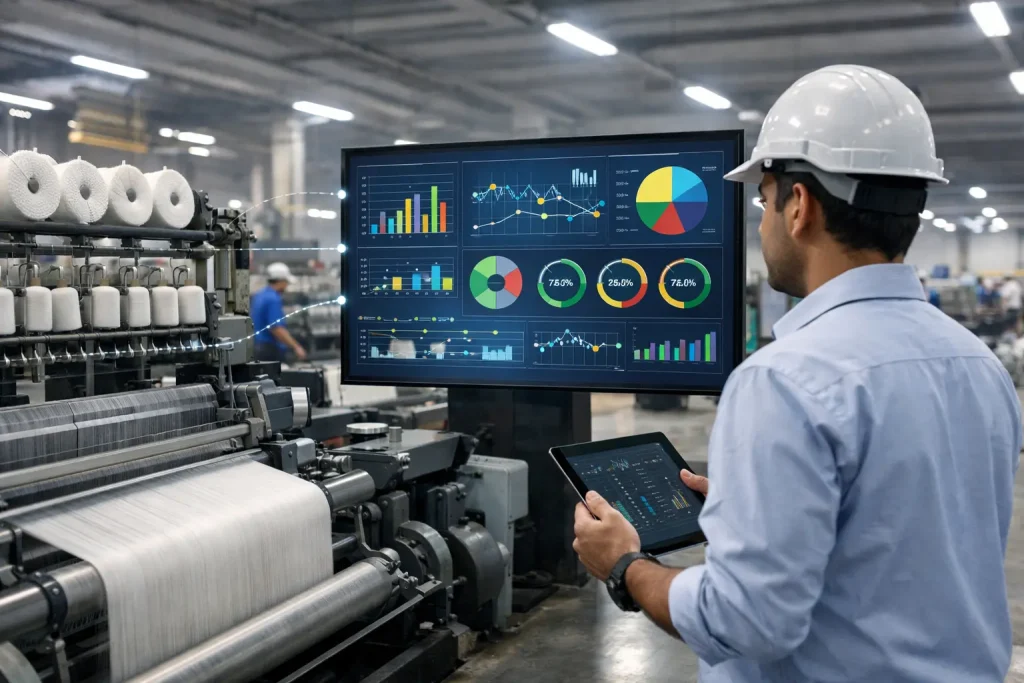
Running a textile mill is not just about keeping machines running. Every day, mill owners and managers deal with machine stoppages, production mismatches, quality complaints, and delivery pressure. In many mills, data is still collected manually through registers or Excel sheets, which creates delays and confusion. This is where MIS in textile mills becomes extremely important. A properly designed textile MIS system gives clear visibility of production, planning, and quality. Instead of guessing what is happening on the shop floor, management gets real data to make better decisions.
What is MIS in Textile Mills?
MIS stands for Management Information System. In simple terms, it is a system that collects data from machines, operators, and departments, then converts this data into meaningful reports and dashboards. These reports help managers understand production performance without relying on verbal updates.
In textile mills, MIS plays the role of a digital bridge between the shop floor and management. It shows how much production is happening, which machines are underperforming, where downtime is occurring, and how quality is being maintained.
Why Textile Mills Need MIS Today
The textile industry has become highly competitive. Buyers expect consistent quality, timely delivery, and cost efficiency. Without accurate and timely data, it becomes difficult to control losses or improve performance.
Many mills face common problems like delayed production reports, mismatched data between departments, and late identification of quality issues. A textile mill management system solves these challenges by providing real-time visibility. When data is available instantly, managers can act immediately instead of reacting after losses occur.
Role of MIS in Textile Production Monitoring
Production monitoring is one of the strongest benefits of MIS. With a textile production monitoring system, mills can track production output in real time across machines, shifts, and operators.
MIS helps supervisors see which machines are running efficiently and which ones are falling behind. Shift-wise and machine-wise performance becomes transparent. This real-time production tracking reduces dependency on manual reporting and improves control over daily operations.
Machine Performance & Downtime Analysis
Machine downtime directly affects productivity and profit. Without MIS, downtime reasons are often recorded late or inaccurately.
MIS automatically captures downtime data and highlights frequent stoppages. It helps identify machines that require frequent maintenance and shows exact reasons behind production losses. By analyzing this data, mills can reduce unnecessary downtime and improve overall machine efficiency.
How MIS Supports Textile Production Planning
Planning without proper data often leads to unrealistic targets and last-minute pressure. MIS brings clarity to production planning by using real production data.
With MIS, mills can plan orders more accurately, understand actual machine capacity, and manage raw material requirements efficiently. Historical data helps planners set achievable targets, reducing stress on both machines and manpower while improving on-time delivery.
MIS for Quality Control in Textile Mills
Quality issues in textile production can damage both reputation and profitability. Manual quality checks often fail to identify repeated defect patterns.
A textile quality control system within MIS continuously records defects at the machine and operator level. This helps management identify recurring quality problems early. Instead of discovering defects at the final stage, quality monitoring happens throughout the production process, reducing rework and rejection.
Key MIS Reports Used in Textile Industry
Reports are the backbone of any MIS system. These reports convert raw production data into useful information for management.
| Report Type | Purpose |
| Daily Production Report | Shows total output per shift |
| Machine Efficiency Report | Identifies best & worst machines |
| Downtime Report | Highlights loss reasons |
| Quality Rejection Report | Tracks defects & wastage |
| Planning vs Actual Report | Measures execution accuracy |
These textile MIS reports replace manual paperwork and help management make faster and more confident decisions.
MIS vs ERP in Textile Industry
MIS and ERP are often confused, but both serve different purposes in textile mills.
| MIS | ERP |
| Focuses on production & shop floor data | Focuses on business processes |
| Real-time machine monitoring | Accounting, HR, inventory |
| Faster decision-making | Long-term business planning |
| Ideal for production control | Ideal for enterprise management |
For best results, many mills integrate MIS with ERP, combining operational control with business management.
MIS Integration with PLC, SCADA & IoT
Modern textile mills are moving towards digital transformation. MIS can be integrated with PLC systems, SCADA platforms, and IoT devices to collect machine data automatically.
This integration enables real-time visualization, better monitoring, and accurate reporting. Such connectivity supports Industry 4.0 textile mills, where decisions are driven by live data instead of assumptions.
Benefits of MIS in Textile Mills
The impact of MIS goes beyond reporting. It improves overall operational discipline within the mill.
With MIS, textile mills experience better production efficiency, reduced downtime, improved quality consistency, and faster decision-making. When accurate data is available daily, management can focus on improvement instead of firefighting.
How to Choose the Right MIS for a Textile Mill
Selecting the right MIS depends on the mill’s size, production type, and future goals. The system should be easy for operators to use while providing detailed insights for management.
A good MIS software for textile industry should offer customization, scalability, and reliable technical support. The goal is to simplify operations, not complicate them.
Future of MIS in Textile Industry
The future of textile MIS lies in advanced analytics and automation. Mills are moving towards predictive maintenance, AI-based quality analysis, and energy optimization.
Smart dashboards and data-driven insights will help textile manufacturers stay competitive and improve profitability in the long run.
Final Thoughts
MIS is no longer optional for textile mills aiming for growth and stability. From production monitoring to planning and quality control, MIS in textile mills creates transparency and control across operations.
A simple, well-implemented MIS turns daily production data into daily improvement and long-term success.