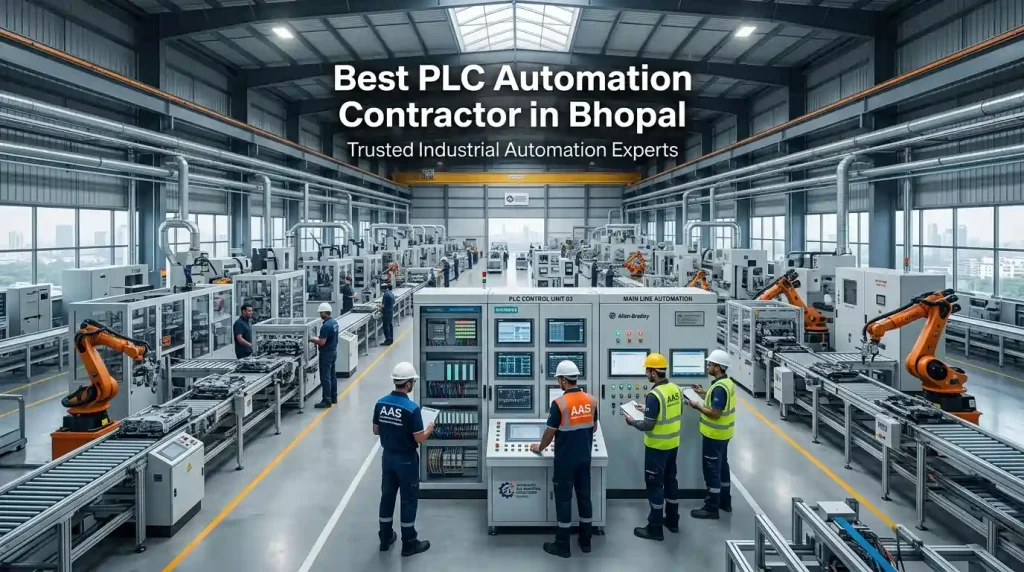
Running a plant without automation today is like navigating a city without a map. You will reach somewhere – but not efficiently, not safely, and not profitably. If you are searching for a reliable PLC automation contractor in Bhopal, you are already asking the right question. The right contractor does not simply deliver a finished panel and walk away. They study your process, design the right logic, commission the system, train your team, and support you long after the project is complete. In this guide, you will understand what PLC automation truly means, how to evaluate every contractor smartly, what to look for before signing a contract, and why choosing the right local partner in Bhopal can protect your plant from costly downtime – while boosting productivity every single day.
WHAT IS PLC AUTOMATION? (Understanding Before Deciding)
What is PLC Automation and Why Does Every Manufacturing Plant Need It?
PLC automation has completely transformed the way factories and industrial plants operate across India. A PLC – or Programmable Logic Controller – is the processing brain of any automated industrial system. It receives signals from sensors and field devices, processes that information based on pre-written control logic, and then sends output commands to motors, actuators, valves, and other equipment – all in real time.
PLC automation for manufacturing plants in India is no longer a luxury reserved for large corporations. It has become a basic operational necessity for any plant that wants to stay competitive. Plants that still depend on manual operations face higher error rates, more workplace accidents, inconsistent quality, and rising labour costs. In contrast, plants using PLC-based systems consistently report significant improvements in output quality, energy efficiency, and production uptime.
So, why does every plant need it? The answer is clear. Human error is reduced dramatically when machines are given precise, repeatable instructions. Equipment runs with consistency 24 hours a day. Real-time data is captured automatically for better management decisions. Energy consumption is monitored and optimized at the source. Additionally, maintenance schedules become predictive instead of reactive, which means breakdowns are caught before they happen.
Across industries – pharmaceutical, food processing, water treatment, textiles, packaging, and infrastructure – PLC automation is the foundation of every modern production facility.
Did You Know? Plants that adopt PLC-based automation report an average 30-40% reduction in operational downtime within the first year of implementation, according to industry studies across Indian manufacturing units.
What Does a PLC Automation Contractor Do? (Role Explained)
Many plant owners confuse a PLC product vendor with a PLC automation contractor in Bhopal. They are very different, and mixing them up is one of the most common – and expensive – mistakes in industrial projects.
A contractor takes full responsibility for the entire lifecycle of your automation project. This starts from understanding your unique process requirements and goes all the way through designing the control logic, programming the PLC, fabricating the panel, completing site installation, testing the full system, commissioning, and providing ongoing after-sales support.
Their core scope of work includes:
- Conducting a detailed process study and identifying automation opportunities in your plant
- Designing control logic based on your specific operational requirements
- Programming using appropriate PLC programming languages such as Ladder Logic (LD), Function Block Diagram (FBD), Structured Text (ST), or Sequential Function Chart (SFC)
- Panel fabrication, wiring, and enclosure assembly
- Site installation, integration, and loop testing
- Commissioning, operator training, and documentation handover
- Ongoing AMC (Annual Maintenance Contract) and breakdown support
A professional contractor does not hand you a finished panel and disappear. They stay actively engaged until your plant is running exactly as designed – and beyond.
Who Needs PLC Automation Services in Bhopal?
PLC automation services in Bhopal are needed across a wide range of industries. Madhya Pradesh has seen consistent industrial growth over the past decade. Bhopal, in particular, is emerging as a hub for pharmaceutical manufacturing, food processing, infrastructure development, and water management projects.
Industries that regularly need these services include food and beverage processing units, pharmaceutical and chemical plants, water treatment and sewage management facilities, packaging and bottling lines, textile manufacturing units, cement plants, and infrastructure and construction projects.
If your plant runs repetitive processes – uses motors, conveyors, pumps, or any kind of sequential operation – you need PLC automation services in Bhopal. The sooner you automate, the sooner your productivity and profitability improve.
Not sure if your plant is ready for automation? Call AKNItech for a FREE Process Assessment: +91-07389942094
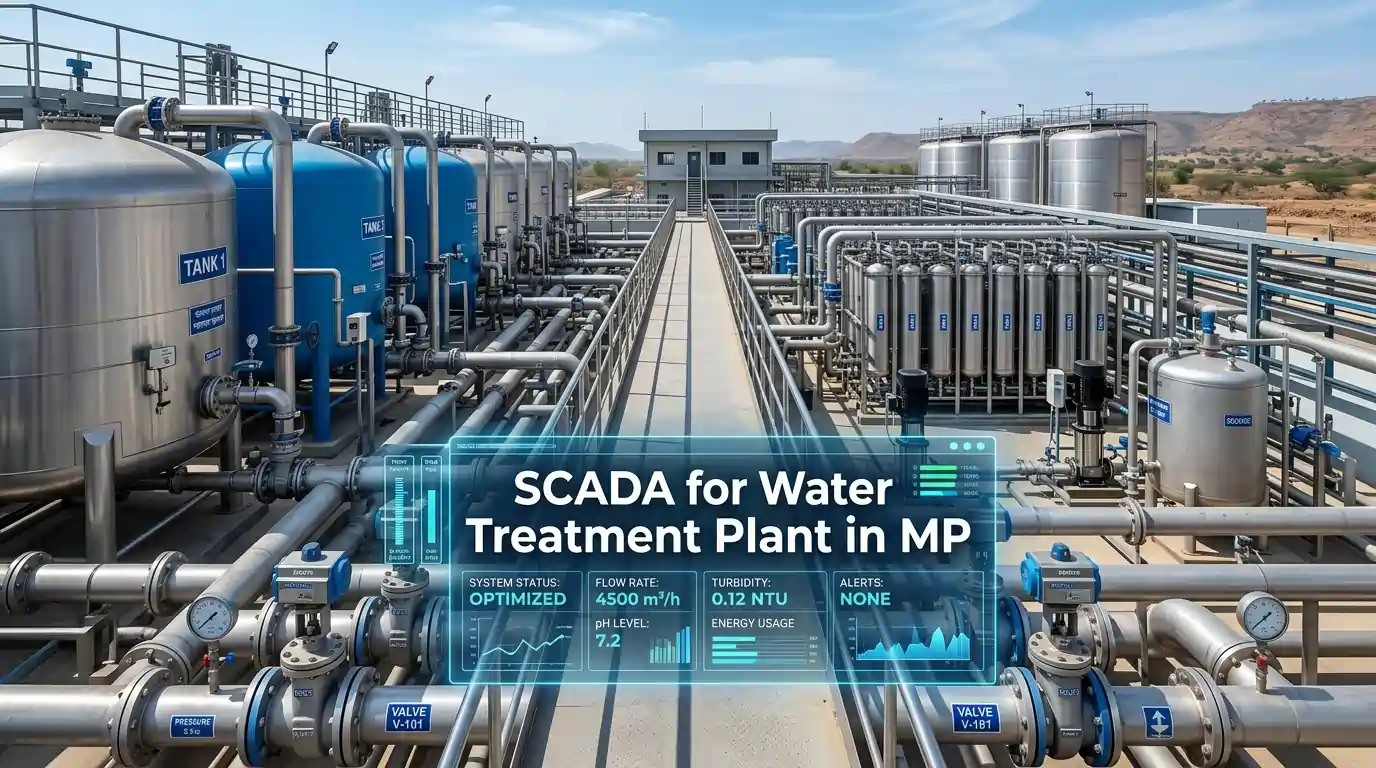
Also Read – SCADA for Water Treatment Plant in MP: How Municipal Bodies & Industries Are Automating in 2026
Understanding PLC Control Panel Components Before You Hire a Contractor
Before you hire anyone, it genuinely helps to understand what goes inside the system you are paying for. PLC control panel components are the physical building blocks of every automation setup. Knowing them allows you to ask better questions, evaluate contractor quality more accurately, and avoid being overcharged for inferior materials.
Key PLC Control Panel Components – What Each One Does:
| Component | Function & Importance |
| CPU Module | The main processing unit – executes all control logic |
| I/O Modules | Input/Output modules that connect sensors and field actuators |
| Power Supply Unit | Provides clean, regulated DC power to the PLC system |
| HMI / Touch Display | Operator interface for real-time monitoring and manual control |
| Communication Modules | Enable Ethernet, MODBUS, PROFIBUS, or PROFINET connectivity |
| Relay / Contactor | Controls high-power devices such as motors, heaters, and valves |
| MCB / MCCB | Circuit protection devices – protect equipment from overloads |
A contractor who thoroughly understands PLC control panel components will design a system that is not just functional – but also safe, maintainable, and scalable for your future expansion.
Which PLC Programming Languages Should Your Contractor Know?
Not all PLCs are programmed the same way. Different applications require different approaches. PLC programming languages are internationally standardized under IEC 61131-3, and a truly skilled contractor should be fluent in at least three of them.
The five standard languages are Ladder Diagram (LD), which is the most common and mimics traditional electrical relay logic; Function Block Diagram (FBD), which is visual and ideal for complex process control; Structured Text (ST), which resembles high-level programming and is excellent for mathematical calculations; Sequential Function Chart (SFC), which is used for step-by-step sequential process applications; and Instruction List (IL), which is low-level and preferred for performance-critical tasks.
When you speak with any potential PLC automation contractor in Bhopal, ask them directly which programming languages they use and in which application scenarios. This single question will immediately reveal the depth of their technical expertise.
HOW TO CHOOSE & WHEN TO ACT (Decision-Making Framework)
How to Choose the Right PLC Automation Company for Your Plant – 7 Key Factors
Selecting the wrong automation partner can cost your plant months of downtime, wasted investment, and serious operational risk. Knowing how to choose the right PLC automation company for your plant comes down to evaluating seven key factors – carefully, not quickly.
Factor 1 – Industry Experience: Every industry has unique process requirements. A contractor with strong experience in pharmaceutical automation may not fully understand the specific demands of a food processing line. Always ask for industry-specific project references and site visit opportunities.
Factor 2 – Brand Authorizations: Does the contractor work with trusted PLC manufacturing companies like Siemens, Allen Bradley, or Schneider Electric? Authorized partners receive genuine components, faster technical support, and access to the latest firmware updates.
Factor 3 – In-House Programming Team: Some contractors outsource the programming work to freelancers. This creates serious delays and accountability gaps when issues arise. Always verify that programming, testing, and commissioning are handled entirely in-house.
Factor 4 – After-Sales Support and AMC: What happens when something fails at 2 AM during a critical production shift? A reliable contractor offers structured 24/7 support and clearly defined AMC plans with guaranteed response times.
Factor 5 – Turnaround Time: How quickly can they respond to breakdowns or modification requests? A locally based contractor gives you a significant advantage over distant national vendors when downtime is expensive.
Factor 6 – Documentation and Training: Every project must come with complete wiring diagrams, program backup files, and operator training. Any contractor who skips documentation is a contractor you should walk away from.
Factor 7 – Transparent Pricing: Hidden charges destroy trust and inflate project costs. A professional PLC automation contractor in Bhopal will always provide a detailed, line-item quotation before any work begins – with no surprises at handover.
Also Read – Secure Remote Access for PLC and SCADA Systems: Best Practices for 2026
PLC Contractor vs In-House Automation Team – Which is the Better Choice?
This is a question that comes up in almost every plant manager’s mind. When comparing PLC contractor vs in-house automation team, the answer depends on your plant’s scale, budget, and long-term operational strategy. Here is a clear side-by-side comparison:
| Parameter | PLC Automation Contractor | In-House Automation Team |
| Cost | Project-based – no fixed salary overhead | High fixed cost: salaries, tools, training |
| Expertise | Multi-brand, multi-industry experience | Limited to internal project exposure |
| Availability | On-call and project-based as needed | Full-time but skills may fall behind |
| Scalability | Easily scaled up for large projects | Hard to scale quickly for big projects |
| Risk | Contractor handles full project risk | Company bears all responsibility |
| Tech Updates | Always current with latest systems | May fall behind on new technologies |
For most small and mid-sized plants in Bhopal, hiring a professional industrial automation contractor in Bhopal is significantly more cost-effective and operationally flexible than building an in-house team from scratch. Furthermore, the breadth of experience a contractor brings from working across multiple industries and brands simply cannot be replicated by a single internal team.
What Qualifications Should a PLC Contractor Have?
This is a critical question that is surprisingly overlooked by many plant owners – and it causes costly problems later. A qualified PLC automation contractor in Bhopal should hold a degree or diploma in Electrical, Electronics, or Instrumentation Engineering. Beyond the degree, they should also carry brand-specific certifications such as Siemens SITRAIN, Rockwell Automation credentials, or Schneider Electric training certificates.
In addition to academic qualifications, practical experience matters more. Look for contractors with hands-on experience across SCADA and HMI platforms, strong documentation capability using E-Plan or AutoCAD electrical tools, and working knowledge of industrial safety standards such as IS/IEC 61508.
Never compromise on qualifications. A poorly programmed PLC is not just an efficiency problem – it is a safety hazard. Machines that are incorrectly automated can injure workers, damage equipment, and expose companies to serious legal liability.
When is the Right Time to Hire a PLC Automation Engineer for Your Plant?
Many plant owners wait far too long before making this decision. By the time they decide to hire a PLC automation engineer in Bhopal, the downtime or financial losses have already piled up significantly. There are clear, recognizable signals that tell you the right time has arrived.
You should act immediately when you are setting up a new production line or greenfield plant. You should also take action when existing machines are breaking down too frequently and maintenance costs are rising. Additionally, if your production capacity needs to scale but adding more manpower has become unsustainable, automation is the answer.
Other clear triggers include facing quality inconsistencies in your output, receiving unusually high and unmonitored energy bills, needing digital production reports and downtime analysis, or planning to meet new compliance and safety standards.
The best time to hire a PLC automation engineer in Bhopal is always before a problem becomes a crisis. Proactive automation investment consistently delivers a far better return on investment compared to reactive emergency repairs.
Did You Know? Research across Indian manufacturing facilities shows that reactive maintenance costs 3 to 5 times more than planned preventive maintenance supported by PLC automation systems. Automation pays for itself faster than most plant owners expect.
How Long Does PLC Automation Installation Take?
How long does PLC automation installation take? This is one of the most practical questions every plant manager asks – and the answer depends on project complexity. However, here is a realistic timeline you can work with when planning:
- Requirement Study and Process Design: 3-7 working days
- Panel Fabrication and Component Assembly: 7-14 working days
- PLC Programming and Simulation: 5-10 working days
- Site Installation and Wiring: 3-7 working days
- System Testing and Loop Checking: 2-5 working days
- Commissioning and Operator Training: 1-3 working days
In total, most small to mid-size projects are completed in 3 to 6 weeks from start to commissioning. Larger, plant-wide automation projects with SCADA integration can take 2 to 4 months depending on scope. A transparent PLC automation contractor in Bhopal will provide you a detailed, week-by-week project schedule before any work begins – so there are no timeline surprises.
Also Read – Analog Scaling in PLC (S7-200 Smart): Practical Explanation for Beginners
Benefits of Hiring a Local PLC Automation Contractor in Bhopal
The benefits of hiring a local PLC automation contractor extend well beyond simple geographic convenience. When your contractor is based in Bhopal or anywhere in Madhya Pradesh, several real and measurable advantages work in your favour every single day.
Speed of Response: Downtime is expensive – sometimes devastatingly so. When a critical system fails on the shop floor, a local PLC automation contractor in Bhopal can be at your site within hours – not days. National companies often take 2-3 days just to dispatch a field engineer, by which time your production has already suffered significant losses.
Knowledge of Local Conditions: Local contractors understand the power supply fluctuations, ambient temperature variations, load patterns, and regulatory environment specific to Madhya Pradesh. This ground-level knowledge directly improves the quality of their engineering decisions and system design.
Cost Efficiency: No travel charges, no accommodation bills, no expensive relocation fees baked into the project cost. A local contractor keeps your total project investment predictable and fair.
Long-Term Partnership: A local contractor becomes more than a vendor over time. They know your plant layout, your production processes, and your team. This continuity is extremely valuable when expansions, upgrades, or process modifications are needed in the future.
Why Hire a Local PLC Contractor Instead of a National Company?
Why hire a local PLC contractor instead of a national company? The answer comes down to two words: accountability and speed.
National automation companies manage hundreds of clients scattered across the country. Your plant is just one account among many. A local PLC automation contractor in Bhopal treats every project as a priority, because their reputation in the local market depends on it. You get direct access to the engineers who are actually working on your system – not a toll-free customer care number that puts you on hold.
Beyond that, local contractors are far more invested in building long-term relationships within their community. If something goes wrong, they are reachable, accountable, and on-site fast. That combination of speed and ownership is something no distant national company can truly replicate.
Ready to Evaluate Your Plant’s Automation Needs? Talk to AKNItech’s Engineers Today – +91-07389942094 | kapil@aknitech.in
HOW TO EVALUATE & MAKE THE RIGHT COMMERCIAL DECISION
What to Look for in a PLC Panel Installation Company in Bhopal – Complete Checklist
Choosing the right PLC panel installation company in Bhopal requires more than just comparing prices on a spreadsheet. The cheapest option is rarely the best option when it comes to industrial automation – where reliability directly impacts your production output. Use this practical evaluation checklist before signing any contract:
- Is the company officially registered with verifiable credentials?
- Do they have documented project experience in your specific industry?
- Are they authorized dealers or certified partners of major PLC brands?
- Do they offer clear warranty terms covering both hardware and programming?
- Is an Annual Maintenance Contract (AMC) available with defined SLAs?
- Can they provide complete AutoCAD or E-Plan electrical drawings for every project?
- Do they have a dedicated in-house team for PLC automation services in Bhopal?
- Can they provide at least 3-5 verified client references from completed projects in your region?
- Is thorough operator training included as part of the project handover?
- Is their pricing structure transparent, detailed, and free from hidden charges?
If a PLC panel installation company in Bhopal checks all ten of these boxes confidently, they deserve serious consideration. If they hesitate on even two or three – ask more questions before proceeding.
Did You Know? Over 60% of industrial automation project failures across India are caused not by faulty hardware – but by poor programming logic, inadequate system testing, and the absence of proper project documentation at handover.
What Makes the Best Automation Contractor in Madhya Pradesh?
The best automation contractor in Madhya Pradesh is not necessarily the largest firm or the most expensive one. Consistently, the best contractors are those who deliver reliable results on time, within budget, and with complete after-sales accountability that does not disappear the moment the final invoice is paid.
Five traits consistently separate the best from the rest. First is technical depth – genuine expertise spanning PLC, SCADA, HMI, VFD programming, and industrial networking. Second is multi-brand experience – the ability to work confidently with Siemens, Allen Bradley, Schneider, and other leading platforms. Third is complete project documentation – every project delivered with full wiring diagrams and program backup files. Fourth is responsive, around-the-clock support – available when you actually need them, not just during business hours. Fifth and most importantly is a high rate of repeat clients – because no metric proves quality more convincingly than clients who keep coming back.
The best automation contractor in Madhya Pradesh builds long-term partnerships, not just one-time project deliveries.
PLC Manufacturers in India – Why Brand Support from Your Contractor Matters
PLC manufacturers in India and globally include established brands like Siemens, Allen Bradley (Rockwell Automation), Schneider Electric, Mitsubishi Electric, and Delta Electronics. Each brand operates its own distinct programming environment, hardware ecosystem, and technical support network.
Why does this matter to you as a plant owner? Because the PLC manufacturing company your contractor works with directly determines the quality, reliability, longevity, and long-term support availability of your automation system.
Leading PLC Manufacturers in India – Brand Support Comparison:
| PLC Brand | Country of Origin | Common Use Case | Authorized Support |
| Siemens | Germany | Large-scale process automation, pharma, infra | SITRAIN certified partners |
| Allen Bradley (AB) | USA | Automotive, food & beverage, packaging lines | Rockwell authorized integrators |
| Schneider Electric | France | Energy, water treatment, building automation | Schneider certified partners |
| Mitsubishi Electric | Japan | Textile, machine tools, conveyor systems | MELCO authorized partners |
| Delta Electronics | Taiwan | SME automation, cost-effective solutions | Delta authorized distributors |
A contractor who is authorized by reputable PLC manufacturers in India brings far more value than one who sources cheap, unbranded components from unknown suppliers. Genuine spare parts are available faster. Warranty claims are processed without delays. Firmware updates are handled correctly. Most importantly, your system is backed by the full technical resources of the brand – not just one local contractor.
Always verify a contractor’s brand authorizations before signing any agreement. Ask for their official certificates. A legitimate authorized partner will always be able to show you proof without hesitation.
Also Read – How Legacy Machines Can Become Smart Without Replacing Them
How Much Does PLC Automation Cost in India?
How much does PLC automation cost in India? This is one of the most frequently asked questions by plant owners and project managers – and the honest answer is: it depends. System complexity, brand selection, number of I/O points, and SCADA requirements all influence the final project cost significantly.
Additional factors that affect cost include the specific PLC brand and model chosen, HMI and SCADA software requirements, panel enclosure size and IP rating, site conditions and cable runs, and the scope of AMC and support included in the contract.
The best approach is always to request a detailed, site-specific quotation from a trusted PLC automation contractor in Bhopal – one that is based on your actual process requirements rather than a generic price list.
Get a Free, No-Obligation Quotation for Your Plant – Contact AKNItech: www.aknitech.in | +91-07389942094
Frequently Asked Questions About PLC Automation Contractor in Bhopal
Q1. How much does PLC automation cost in India?
PLC automation costs vary based on system size and project complexity. Small systems start from ₹80,000, while large plant-wide automation with SCADA integration can exceed ₹30 lakhs. The best approach is to request a customized quote from a trusted PLC automation contractor in Bhopal who can assess your specific process requirements before providing pricing.
Q2. What qualifications should a PLC contractor have?
A qualified contractor should hold a relevant engineering degree or diploma, along with brand-specific certifications from Siemens (SITRAIN), Schneider Electric, or Allen Bradley. Beyond formal qualifications, they should have proven hands-on experience in industrial projects, strong documentation capability in E-Plan or AutoCAD electrical, and a working knowledge of industrial safety standards.
Q3. How long does PLC automation installation take?
A small to mid-size project typically takes 3 to 6 weeks from initial design through to final commissioning. Larger, plant-wide projects can take 2 to 4 months depending on scope and complexity. A reliable contractor will always provide you a detailed project schedule upfront – before any work begins – so timelines are clear and commitments are kept.
Q4. What is the difference between PLC and SCADA?
A PLC (Programmable Logic Controller) operates at the field level – it directly controls physical equipment like motors, pumps, and valves based on its programmed logic. SCADA (Supervisory Control and Data Acquisition) operates at a higher supervisory level – it monitors, collects data from, and manages multiple PLCs from a centralized control room interface. In most modern plants, PLC and SCADA work together as one integrated automation system.
Q5. Why hire a local PLC contractor instead of a national company?
Local contractors offer faster on-site response times, lower project costs with no travel surcharges, and a deeper understanding of regional operating conditions. A PLC automation contractor in Bhopal who is familiar with your plant, your team, and your local environment will consistently outperform a distant national vendor in speed, accountability, and long-term support quality.
Why AKNItech is the Most Trusted PLC Automation Contractor in Bhopal for Your Plant
When it comes to choosing a PLC automation contractor in Bhopal, AKNItech stands apart from the competition – and the results speak clearly. With a highly skilled team of 12 engineers and technicians, multi-brand expertise spanning Siemens, Allen Bradley, Schneider Electric, and AVEVA, and a track record of 134+ successfully delivered automation projects, AKNItech brings real technical depth combined with genuine local accountability.
From PLC automation and HMI/SCADA designing to VFD programming, panel fabrication, industrial networking, and AutoCAD electrical drawings – every aspect of your automation project is handled under one roof. AKNItech’s clients across Madhya Pradesh choose them repeatedly because of one straightforward reason: they deliver exactly what they promise, on time, and they stand behind every project long after commissioning is complete.
Whether you are setting up a new production line, restoring old machines, or completely re-engineering your process automation, AKNItech has the engineering expertise, brand partnerships, and local presence to get it done right the first time.
Take the First Step Toward Smarter Automation – Contact AKNItech Today
Call: +91-07389942094 | +91-7400726548
Email: kapil@aknitech.in | anirudh.dharik@aknitech.in
Website: www.aknitech.in
ddress: Plot No. 407/2, Barkheda Pathani, Near Awadhpuri Police Station, Bhopal, MP – 462022
Office Hours: Monday-Saturday, 10:00 AM – 6:00 PM
Request a Free Plant Automation Consultation – Our Engineers Are Ready to Visit Your Site