Manufacturing units generate an enormous amount of information every single minute, and this is exactly why industrial mis systems have become essential in modern factories. PLCs fire logic sequences, sensors push readings, SCADA logs events, and operators make manual entries – yet most factories struggle to bring all this scattered data into one meaningful structure. An industrial mis systems closes this gap by acting as the central brain of the plant. It capture data from machines, cleans and organizes it, evaluates performance, and provides insights that help teams make faster, smarter decisions.
Somewhere behind the scenes an Industrial MIS System is quietly gathering all this information, trying to make sense of the nonstop noise. Most people see only the final dashboard – the colorful KPIs and graphs but the real magic begins long before that.
Where Does All the Plant Data Come From? A Factory Management Information System Perspective
An Industrial MIS, often called a factory management information system, is designed specifically for production plants. It connects with PLCs, SCADA, sensors, EMS, maintenance logs, and ERP modules to provide a unified operational view. Unlike normal MIS used in offices, an industrial MIS deals with real physical processes inside the plant – machine behavior, energy usage, cycle time, output quality, and breakdown patterns.
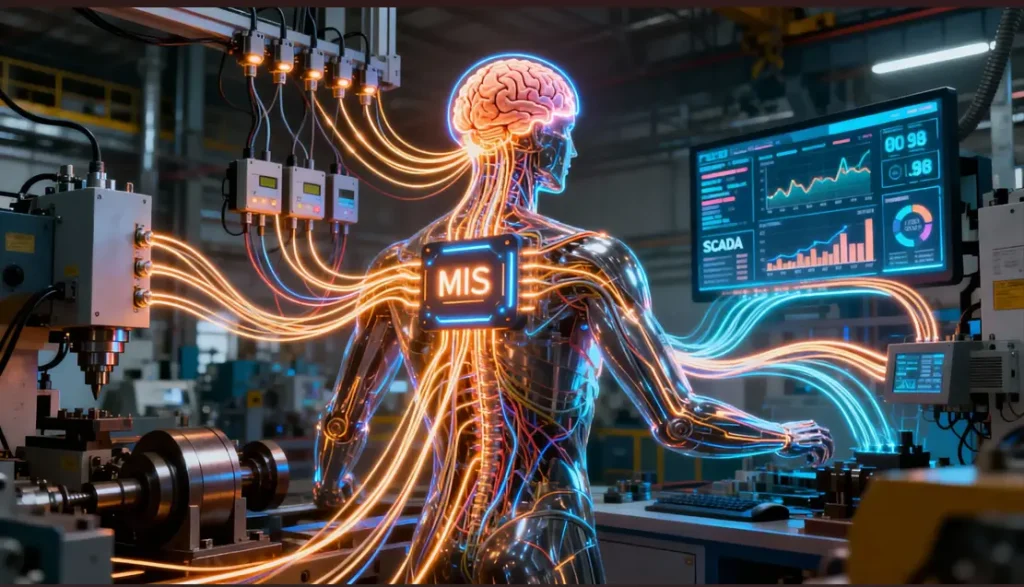
Think of the plant as a human body. Sensors act like nerve endings. PLCs serve as reflexes. Machines are the muscles. SCADA is the central nervous system. And the MIS functions like the brain – interpreting everything.
A factory management information system receives data from:
- PLCs reporting RPM, temperature, cycle counts
- SCADA systems logging alarms and events
- IoT devices tracking micro-parameters
- ERP systems providing production plans
- Operators entering downtime reasons
- Maintenance teams adding repair notes
Some data arrives instantly and some arrives late, and some arrives in formats that make no sense at all but the MIS system takes it all in.
How MIS Uses a Plant Data Collection System to Pull Machine Information
A plant data collection system works closely with Industrial MIS Systems to gather information from every corner of the manufacturing unit. It connects to PLCs to pull machine signals, reads sensor values for temperature or pressure, and communicates with scada historians for alarm logs and trends. It also collects shift wise production entries, downtime reasons, energy readings, and ERP-based batch data. By combining all these sources into one flow, the MIS ensures nothing inside the factory goes unnoticed.
A Plant Data Collection System may use OPC servers, MQTT, direct PLC communication, or older protocols like Modbus and Profibus. Sometimes the connection is perfect, and sometimes one loose cable sends half the plant into silence.
MIS is built to handle real-world chaos:
- Retrying communication
- Flagging missing values
- Buffering temporary data
- Switching to backups when needed
This imperfect data pipeline is the first layer of MIS intelligence.
Data Normalization in Manufacturing: Turning Raw Data into Reliable Insights
Data entering the MIS is often messy and inconsistent. Machines use different formats, sensors might fluctuate due to electrical noise, and timestamps may not align. Data Normalization in Manufacturing solves these issues by cleaning, standardizing, and structuring all incoming information. Units are converted to consistent values, naming conventions are unified, missing or duplicate readings are corrected, and datasets are aligned by time. Once normalized, plant data becomes ready for accurate reports and analytics.
If data collection is the noisy part, industrial mis systems rely heavily on Data Normalization in Manufacturing to make that data usable.
Factories generate some of the messiest data imaginable:
- Celsius in one place, Fahrenheit in another
- Liters vs gallons
- Mismatched timestamps
- Spikes caused by sensor noise
- Operator entries that read like riddles
Normalization fixes everything by:
- Converting units
- Aligning timestamps
- Filtering noise
- Standardizing naming conventions
- Filling missing values
- Mapping technical tags to human-readable names
Without normalization, MIS dashboards would look confusing, unreliable, and impossible to use.
How MIS Stores and Processes Information for Manufacturing Data Analytics
After normalization, the MIS stores information inside databases and historians built for long-term analysis. This architecture allows manufacturing data analytics to run efficiently on months or even years of machine behavior. Historical data becomes easy to access, whether analyzing production patterns, maintenance logs, or energy trends. The structured storage ensures that even large volumes of time-stamped readings remain organized and ready for evaluation.
MIS builds a stable foundation so engineers, managers, and auditors can easily search, compare, and evaluate performance over time.
Real-Time Plant Monitoring: The Evaluation Stage Where MIS Becomes Intelligent
With normalized data stored properly, industrial mis systems begin evaluating plant operations through real-time insights. Through real-time plant monitoring, the system tracks live values, alerts teams about abnormal conditions, and highlights trends in performance. This includes calculating KPIs such as cycle time, energy per unit, machine efficiency, rejection rate, and downtime percentage. MIS converts endless data streams into practical dashboards and insights that decision-makers can act on immediately.
MIS analyzes:
- OEE
- Downtime percentages
- Quality deviations
- Energy consumption
- Shift-level productivity
- Machine behavior under different loads
It highlights inefficiencies, detects unusual behavior, and identifies hidden bottlenecks.
A minor speed drop at 3 PM, a rising temperature trend, or a slow increase in torque – MIS sees patterns humans miss.
Reducing Downtime with SCADA and PLC Data Integration
One powerful use case of industrial mis systems is downtime reduction through deep data correlation. Through SCADA and PLC data integration, the system correlates alarms, machine states, and operator remarks to identify the true causes of breakdowns. This helps maintenance teams detect patterns like repeating electrical faults, delayed operator response, or overheating equipment – leading to targeted preventive actions that significantly reduce unplanned stoppages.
Imagine the MIS correlating SCADA alarms with PLC cycle data, then comparing it with operator notes. Through SCADA and PLC data integration, MIS exposes the true reasons behind breakdowns.
Maybe a valve sticks every few hours.
Maybe a motor overloads during heat spikes.
Maybe a human error keeps repeating on the same shift.
This insight helps maintenance teams take smarter, faster action.
Boosting Productivity with Accurate Production and Downtime Reporting
Accurate production and downtime reporting gives managers a clear picture of what is happening on the shop floor. MIS tracks shift output, stoppages, quality results, and cycle variations to highlight bottlenecks and improvement opportunities. With data-driven visibility, plants can improve planning, stabilize production, and increase output without major investments.
Patterns become visible:
- Which line slows down
- Which machine struggles with heat
- Which operator resolves issues fastest
- Which batch causes the most rejections
When reporting becomes reliable, planning becomes powerful.
Why MIS for Industrial Automation Is the Future of Modern Manufacturing
Modern factories depend on MIS for Industrial Automation because it brings structure to complex operations. With dependable data and real-time insights, managers can optimize processes, improve machine reliability, reduce energy costs, and strengthen quality control. An MIS becomes the foundation for advanced tools like predictive maintenance, energy optimization, and machine learning analytics.
With rising competition, manufacturers can’t rely on guesswork. MIS for Industrial Automation offers the clarity plants need to operate efficiently, reduce waste, and maintain quality.
From predictive maintenance to energy optimization and digital transformation, MIS is the foundation for every modern Industry 4.0 initiative.
Conclusion: The Quiet Intelligence Behind Every Smart Factory
Industrial MIS systems do much more than collect data. They act like the brain of the factory – absorbing raw signals, organizing them, evaluating insights, and telling the real story behind machine behavior.
By combining data collection, normalization, evaluation, and reporting, MIS helps factories reduce downtime, improve quality, save energy, and increase productivity.
In a world where manufacturing demands speed, precision, and reliability, MIS is the silent partner keeping factories efficient, predictable, and future-ready.
FAQs
1. What is an Industrial MIS System in manufacturing?
An Industrial MIS System collects, organizes, and analyzes plant data from PLCs, SCADA, sensors, and ERP to generate KPIs and real-time insights for better decision-making.
2. How does an MIS collect data from machines and sensors?
MIS gathers data through OPC servers, MQTT, Modbus/Profibus, PLC communication, SCADA historians, IoT devices, and manual operator entries.
3. What is data normalization in an MIS system?
Data normalization cleans and standardizes raw plant data by fixing units, timestamps, noise, and tag names to make it ready for accurate analysis.
4. Why is data normalization important in manufacturing?
It ensures consistency and accuracy, removes noise, unifies formats, and makes machine data reliable for reports and decision-making.
5. How does MIS evaluate production and machine performance?
MIS calculates KPIs, analyzes trends, monitors machine behavior, and detects anomalies to identify inefficiencies and bottlenecks.
6. How do scada and plc data integration improve MIS reporting?
They provide combined insights from alarms, machine states, and cycle data, helping pinpoint true downtime causes and issues.
7. What is a Plant Data Collection System in MIS?
It is the mechanism MIS uses to gather data from PLCs, sensors, SCADA logs, ERP modules, and energy meters.