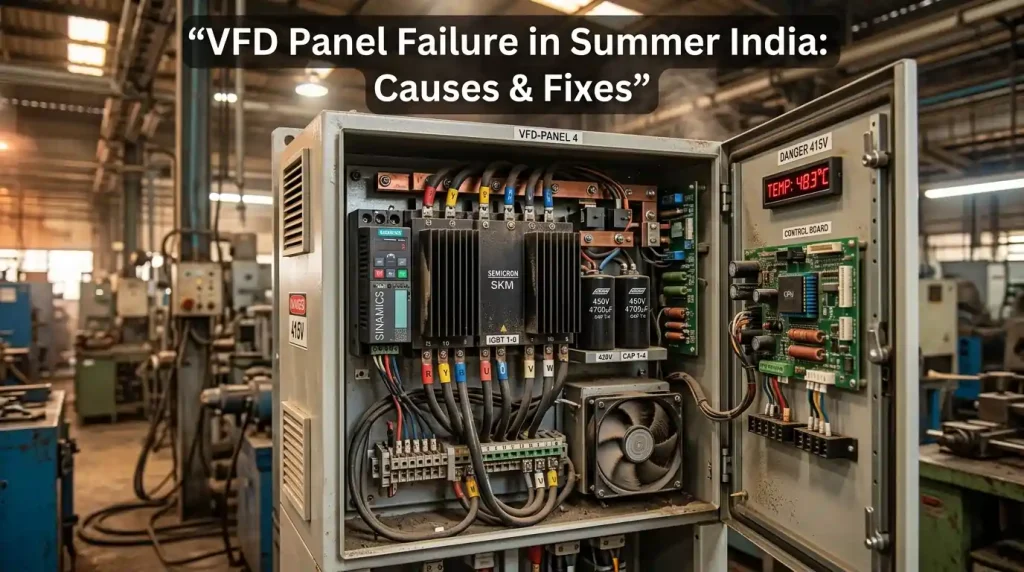
It is April. Your factory is running at full capacity. Temperature outside has already touched 44°C. And then – without any warning – your production line stops. The VFD panel has tripped again.
Sound familiar?
If you run a plant anywhere in India – whether in Madhya Pradesh, Gujarat, Maharashtra, or Rajasthan – you already know that VFD panel failure in summer India is not just a technical problem. It is a production problem, a money problem, and sometimes a safety problem too.
Every year, between April and June, maintenance teams across Indian factories deal with a sudden spike in VFD failures. The drives trip, alarms go off, and the entire production line goes down. And in most cases, the root cause is something completely preventable.
In this guide, we are going to break down exactly why this keeps happening, what you can do to stop it, and what role the right industrial automation partner plays in keeping your plant running through the toughest months of the year.
Let us start from the very beginning.
What Is a VFD (Variable Frequency Drive) and Why Do Indian Industries Depend on It?
VFD full form in electrical engineering is Variable Frequency Drive. You may also hear it called a variable speed drive, AC drive, or inverter drive. In simple terms, a VFD controls how fast or slow an electric motor runs – by changing the frequency of the power supply going into the motor.
Think of it like a throttle on a motorbike. Instead of the motor always running at full speed, a VFD lets you control the exact speed needed for each task – no more, no less. This saves a huge amount of electricity.
A VFD starter is used at the time of starting a motor to gradually bring it up to speed, instead of hitting it with full power at once. This reduces mechanical stress on the motor and saves energy during every startup. That is why VFDs are now used everywhere – water pumps, conveyor belts, HVAC systems, compressors, textile machines, packaging lines, and more.
In India, with rising electricity costs and increasing pressure to reduce downtime, factories have adopted VFDs at a very fast pace over the last decade. But with more VFDs in use comes more risk – especially when Indian summers arrive and temperatures go through the roof.
Also Read – VFD Trip Fault Codes Explained
Why Does VFD Panel Failure in Summer India Happen More Than the Rest of the Year?
Here is the short answer: VFDs are built like computers. And computers absolutely hate heat.
Every VFD has a maximum safe operating temperature that the manufacturer sets. For most standard drives available in India – whether Siemens, ABB, Delta, Schneider, or Danfoss – that maximum safe limit is 40°C ambient temperature. “Ambient” means the temperature of the air around the drive, inside the panel cabinet or panel room.
Now think about India in May. The outdoor temperature in industrial cities like Nagpur, Bhopal, Indore, Ahmedabad, and Ludhiana regularly crosses 45°C to 48°C. Inside a factory – especially near running machines and boilers – the temperature can climb even higher. This means the air going into your VFD panel is already at or above its safe limit – before the drive even starts generating its own internal heat.
This is the main reason why VFD trips in summer are so common across Indian factories. The drive works hard, generates heat, and has nowhere to push that heat out. It trips on thermal overload to protect itself. If the thermal protection does not work in time – components begin to fail permanently.
This is the single biggest driver behind the spike in VFD panel failure in summer India every single year.
| Did You Know? Most VFDs are rated for a maximum ambient temperature of 40°C. But in many Indian industrial zones, the temperature inside panel rooms can reach 50°C to 55°C during peak summer. That is 10°C to 15°C above the safe limit – enough to cut a VFD’s operational lifespan by up to 50%, according to industry studies on thermal component degradation. |
How Indian Summer Crosses the 40°C Rated Limit – and What Happens Inside the VFD
Inside a VFD, the main heat-generating component is called the IGBT – Insulated Gate Bipolar Transistor. Think of the IGBT as the brain that controls how electricity flows to the motor. When the temperature around the IGBT rises beyond safe levels, it starts to degrade – first slowly, then rapidly.
The VFD ambient temperature limit of 40°C is not an arbitrary number. Industry research consistently shows that every 10°C rise above the rated limit can double the stress on electronic components. Capacitors dry out faster. Circuit boards expand and contract repeatedly with heat cycles, creating micro-cracks in solder joints. The internal cooling fan has to work much harder and eventually wears out ahead of schedule.
By the time a plant engineer notices something is wrong – through a fault code on the display, a burning smell from the panel, or a sudden production stop – the internal damage may already be done and the component may need full replacement.
Also Read – How VFD Panels Improve Soft Acceleration in High-Torque Machinery
How Dust Silently Causes VFD Panel Failure – The IGBT Burnout Nobody Warns You About
Heat alone does not cause most VFD failures in India. Dust makes everything far worse.
In Indian factories – especially in industries like cement, textile, food processing, cotton ginning, and foundries – fine dust particles are always present in the air. These particles enter the VFD through the cooling vents during normal operation. Over time, a thin grey layer of dust settles on the heatsink fins, on the cooling fan blades, and on the circuit board surface.
Here is why that is so dangerous. Dust acts exactly like a blanket. It does not let heat escape from the heatsink. The heatsink’s entire job is to pull heat away from the IGBTs and release it into the surrounding air. When it is covered in dust, it cannot do that job. The IGBT temperature keeps climbing – quietly, with no alarm – until it hits the failure point.
The dust effect on VFD panel IGBT failure is far more serious than most engineers realize. When conductive dust particles – such as metal filings, carbon particles, or moisture-laden cotton dust – settle on the PCB (printed circuit board), they can create unintended electrical paths between components. This leads to short circuits. Not slow degradation – but sudden, complete, and often irreversible failure.
| Field observation from AKNItech engineers in Central India: A brand-new VFD working perfectly in December was found completely failed by May of the same year. Not because of age – but because cooling fan maintenance was skipped for four months and dust had fully blocked the heatsink airflow. |
| Did You Know? A layer of dust just 1 to 2mm thick on a VFD heatsink can reduce its heat dissipation efficiency by 30 to 40%. In Indian summer conditions, this alone is enough to push the internal temperature past the critical IGBT failure point – even on a drive that is only 1 to 2 years old. |
Where Does Dust Accumulate in a VFD Panel and How to Spot It Before It Causes Damage
Dust does not just collect on the outside of the panel. It accumulates in very specific spots inside the drive where it does the most damage:
- On the heatsink fins – the metal ridges at the back or bottom of the drive unit
- On the cooling fan blades – reducing airflow gradually and silently over weeks
- On the PCB surface and capacitor tops – creating electrical leakage paths
- At the vent openings – partially or fully blocking the air intake
VFD cooling fan maintenance for industrial India environments should include a monthly visual check. Open the panel door. If you can see a grey or brown layer of dust on the heatsink or fan blades – it is already overdue for cleaning. Do not wait for a fault code or a trip. By then, the heat stress on the IGBT may already have shortened the component’s life significantly.
Difference Between VFD and Soft Starter – Which One Fails Faster in Indian Summer?
This is one of the most common questions that plant engineers and maintenance managers ask us across India. And the answer matters a lot – especially when you are choosing equipment for a hot, dusty factory environment.
A soft starter is a device that controls only the starting and stopping of a motor. Once the motor reaches its rated full speed, the soft starter hands over control and steps out of the circuit completely. It does not control motor speed during normal running operation.
A VFD (Variable Frequency Drive), on the other hand, controls motor speed continuously – from start to stop and everything in between. This means a VFD is always active, always converting power, and always generating heat throughout the entire operation.
Here is a clear comparison to help you understand the key differences:
| Feature | VFD (Variable Frequency Drive) | Soft Starter |
| Controls motor speed? | Yes – continuously during operation | No – only during start and stop |
| Heat generated | High (always active in circuit) | Low (active only briefly) |
| Summer failure risk in India | Higher – needs active cooling management | Lower – less heat stress |
| Energy savings | Very high – 30 to 50% savings possible | Moderate – mainly startup savings |
| VFD programming needed? | Yes – regular parameter review needed | Minimal |
| Cost | Higher initial investment | Lower initial investment |
| Best use case | Pumps, fans, conveyors, compressors | Crushers, conveyors, large motors |
So in terms of soft starter vs VFD heat generation, a soft starter produces far less heat during operation and is therefore less vulnerable to summer failures. However, this does not mean you should swap out all your VFDs for soft starters.
Is a Soft Starter Better Than a VFD for Dusty, High-Temperature Indian Factory Conditions?
Not always – and here is why. The difference between VFD and soft starter is not just about heat generation. If your process requires continuous speed control – a soft starter simply cannot do that job.
For applications like water pumps, cooling towers, HVAC fans, and textile weaving machines – a VFD is still the right choice because it delivers energy savings that a soft starter cannot match.
What matters most is protection. A properly maintained VFD in a well-designed, correctly rated enclosure will outlast a poorly maintained soft starter every single time. The goal is not to choose one device over the other – it is to protect whichever device you are running.
Also Read – VFD Auto-Tuning: Why 80% Engineers Don’t Use It Properly
Who Faces Maximum Loss from VFD Panel Failure in Summer India – Industry-wise Breakdown
VFD panel failure in summer India does not hit every industry equally. Some sectors face much higher risk because of the combination of dusty environments, continuous 24/7 operation, and very high ambient temperatures in their facility.
Based on our field experience across Central India, here are the sectors where summer VFD failures are most destructive:
- Textile mills in MP, Gujarat, and Maharashtra – running 24 hours a day, heavy fibre and cotton dust in the air, very high risk category
- Cement plants in MP, Rajasthan, and Andhra Pradesh – cement dust is conductive and extremely dangerous when it enters VFD components
- Food processing units – high humidity combined with heat causes rapid capacitor drying and PCB corrosion
- Water treatment plants and pumping stations – often semi-outdoor panels exposed to direct solar heating
- Pharmaceutical manufacturing plants – strict uptime requirements make any VFD failure extremely expensive
- Packaging and printing facilities – paper dust combined with heat causes PCB tracking failures
If your plant falls into any of these categories and your VFD panels have not been inspected before this summer season – the time to act is right now.
How to Prevent VFD Panel Failure in Summer India – 7-Point Maintenance Checklist
VFD preventive maintenance in India is the single most effective action you can take to avoid summer failures. Below is the exact checklist that AKNItech engineers follow before every Indian summer season across all client plants:
- Clean heatsinks and fan blades – Use dry compressed air to blow out dust build-up every single month. Never use wet cleaning methods on live or recently-powered panels. Pay special attention to the heatsink fins at the back of the drive.
- Check and replace the cooling fan – VFD cooling fan maintenance for industrial India environments should include testing the fan for proper RPM and airflow. Replace fans every 3 to 4 years proactively. Listen for grinding, rattling, or reduced airflow noise.
- Inspect capacitors visually – Look for bulging tops or any signs of electrolyte leakage around the base. Capacitors that are 5 or more years old in high-heat Indian environments should be replaced before summer, not after failure.
- Verify enclosure IP rating and door gaskets – Check that all panel door gaskets are completely intact and sealing properly. A single cracked gasket lets dust and monsoon humidity inside, turning a safe enclosure into a failure waiting to happen.
- Review VFD programming settings – Check thermal overload settings, carrier frequency, and motor Full Load Amps (FLA) entries. Wrong parameters cause the VFD to run hotter than necessary. This is covered in detail in Section 8 below.
- Test the panel room cooling system – If your VFD room has an air conditioner, exhaust fan, or industrial cooler, confirm it is working at full efficiency before April. Check and clean all filters. A failed panel room cooler can destroy multiple VFDs in a single hot day.
- Review the VFD fault history log – Check the drive’s internal fault memory. Repeated thermal overload trips in the past three months are a clear warning that a failure is coming very soon. Act on these signals before summer arrives.
| Did You Know? According to field data collected from industrial plants across Central India by AKNItech engineers, more than 65% of all VFD failures that occur between April and June can be directly traced to maintenance tasks that were skipped during the January to March window. Scheduling your annual maintenance before the heat arrives is the single highest-return investment in uptime you can make. |
When Should You Schedule VFD Preventive Maintenance in India – Before Summer or During?
Always before summer – not during it. February and March are the ideal months for VFD preventive maintenance in India. By the time April arrives, temperatures are already climbing and the thermal stress on your drives is already building.
Waiting until the drive actually trips means you have already lost production time, paid emergency repair costs, and possibly damaged the drive beyond a simple repair. A single properly planned maintenance visit in February or March can prevent a week or more of costly downtime in May or June.
Also Read – What is TIA Portal? A Complete Beginner’s Guide to Siemens Automation System
Which VFD Panel Cooling Solutions Work Best for Industrial Environments in India?
There is no single answer that fits every factory. The right cooling solution for your VFD panel depends on your specific dust levels, ambient temperature range, operating hours, and budget. Here are the four main options and when each one makes sense:
- Forced air ventilation with filtered intake – Best for factories with light or moderate dust. A fan draws cool air in at the bottom and exhausts hot air from the top. Intake filters must be cleaned or replaced every 30 days in dusty environments. Provides VFD overheating protection for industrial panels at the lowest cost.
- Closed-loop heat exchanger – Ideal for dusty or corrosive environments like cement or foundry facilities. The panel is fully sealed. A heat exchanger transfers thermal energy from inside to outside without allowing any outside air – and its dust – to enter. An excellent long-term solution.
- Panel-mounted air conditioner unit – Best for facilities where VFDs run 24 hours a day or where ambient temperatures regularly exceed 42°C. More expensive to install and maintain, but it is the most reliable VFD panel cooling solution for Indian industrial environments. Keeps internal temperature at a stable 25 to 30°C regardless of outdoor conditions.
- Thermal derating via VFD programming – Many modern VFDs from brands like Siemens, ABB, and Delta have built-in thermal derating features that automatically reduce motor output when drive temperature rises. This is not a cooling solution on its own, but when properly configured in the VFD programming, it acts as a critical safety net.
Is IP54 Rating Enough for VFD Panel Dust Protection in Indian Factories?
IP54 VFD panel dust protection means the enclosure is protected against limited dust ingress and splash water from any direction. For general factory environments with moderate dust levels, IP54 is adequate and is the most common rating used in Indian industrial panels.
However, for cement plants, steel foundries, cotton ginning mills, or any factory located near dry agricultural fields – IP55 or IP65 is a significantly better choice. The cost difference between IP54 and IP55 enclosures is small. The cost difference between a protected drive and a completely failed one is not.
How Wrong VFD Programming Accelerates VFD Panel Failure in Summer India
This is the gap that almost no competitor covers – and it is one of the most important factors in preventing summer failures.
VFD programming is not a one-time job done at installation and then forgotten. When an engineer first sets up a VFD, the parameters are configured based on the conditions at that time. But as seasons change and summer arrives, some of those settings become inadequate – or even actively harmful.
Here are the most common VFD programming errors that accelerate summer failures in Indian plants:
- Carrier frequency set too high – A higher carrier frequency means more IGBT switching cycles per second, which means more heat generation. Reducing the carrier frequency from 8kHz to 4kHz during summer months can meaningfully reduce drive temperature without affecting most applications.
- Thermal overload threshold entered incorrectly – If this protective parameter is set too high, the drive will not protect itself in time when it is overheating. Many drives arrive from installation with this setting at factory default, which is often not calibrated for Indian ambient temperatures.
- Motor FLA (Full Load Amps) entered wrong – If the motor’s full load current has been entered incorrectly, the VFD calibrates its protection incorrectly. This can cause it to push more current than the motor or the drive itself can safely handle in high heat conditions.
- Thermal derating not configured – Most VFDs support a feature that automatically reduces output current when internal temperature rises above a set threshold. If this is not enabled and configured, the VFD will try to maintain full output power even as it is overheating – which significantly accelerates component failure.
A simple 30-minute parameter review by a qualified engineer before summer begins can prevent a complete VFD burnout that costs far more than the review itself.
Where to Get Reliable VFD Repair Services and Panel Manufacturing in India – What to Look For
If your VFD has already failed, or if you want to get your panels properly protected before this summer hits, here is what to look for in a reliable industrial automation partner in India:
- Minimum 5 years of hands-on VFD repair and programming experience across multiple brands
- Works with all major VFD brands – including Allen Bradley, Siemens, Schneider, Delta, Danfoss, and ABB
- Manufactures panels with the correct IP rating for your specific factory environment
- Has direct field experience in Indian industrial conditions – not just classroom or textbook knowledge
- Provides site visits and on-site diagnosis, not just phone or remote support
- Has real references from plants in your industry sector
Stop VFD Panel Failure in Summer India Before It Stops Your Production
Let us be direct. VFD panel failure in summer India is not a mystery. It follows a completely predictable pattern every single year. Heat builds up. Dust accumulates. Maintenance gets postponed. Drives fail.
The excellent news is that it is almost entirely preventable with the right preparation and the right maintenance partner.
After reading this guide, you now know exactly why VFDs fail when temperatures cross 40°C, how dust destroys IGBTs from the inside, the real difference between a VFD and a soft starter in Indian conditions, which industries carry the highest risk, the complete 7-step checklist to protect your drives, why VFD programming settings matter more in summer, and which cooling solutions actually work in Indian industrial environments.
The question now is simple: are you going to wait for the next trip to stop your production – or act before it happens?
| Ready to Protect Your VFD Panels Before This Summer? Talk to AKNItech – Bhopal’s Trusted VFD Panel Manufacturer and Repair Specialist At AKNItech, we have been protecting factories across India from summer VFD breakdowns since 2014. With 10+ years of hands-on field experience, export-quality panel manufacturing, and a team that understands Indian industrial conditions from the ground up – we are the partner your plant needs before summer hits. What AKNItech offers for your VFD protection: 1. On-site VFD inspection and preventive maintenance before summer 2. VFD repair and parameter reprogramming for all major brands 3. Custom IP55 / IP65 VFD and soft starter panel manufacturing in Bhopal 4. Summer-ready panel upgrades with the right cooling solutions for your environment 5. Annual Maintenance Contracts (AMC) for year-round VFD protection Call us: +91-7389942094 | Visit: www.aknitech.in Plot No. 407/2, Barkheda Pathani, Awadhpuri, Bhopal, Madhya Pradesh – 462022 |
Frequently Asked Questions About VFD Panel Failure in Indian Summer
Q: What is the single biggest reason for VFD panel failure in summer India?
A: The most common cause is the ambient temperature crossing the 40°C maximum rated limit of most VFD drives, combined with dust accumulation that blocks the heatsink cooling. Together, these two factors push internal IGBT temperatures past the failure threshold – causing permanent component damage.
Q: How often should VFD cooling fans be cleaned in Indian summer conditions?
A: In dusty Indian factory environments – especially textile, cement, and food processing – VFD cooling fan maintenance should be done every 30 days during summer (April to July) and every 60 days during the cooler months.
Q: What is the real difference between VFD and soft starter for Indian factories?
A: A VFD controls motor speed continuously throughout operation, which makes it far more capable for energy saving and process control – but also means it generates more heat. A soft starter only manages motor starting and stopping, generates less heat, but cannot control speed. For most Indian industries that need speed control, a VFD remains the right choice with proper protection.
Q: Is IP54 rating enough for VFD panel dust protection in Indian factories?
A: For normal general-purpose factory environments, IP54 is adequate. For cement plants, foundries, cotton mills, or any facility with heavy airborne dust, IP55 or IP65 enclosures are strongly recommended to prevent dust-related VFD failures.
Q: When is the best time to schedule VFD preventive maintenance in India?
A: February and March are the ideal months. This gives your team enough time to identify and repair any issues before the April–June heat season begins. Scheduling maintenance after a failure in summer costs significantly more – in both repair costs and lost production time.