Hello friends! Welcome back to our Industrial Networking series. In the last episode, we explored what industrial networking is. Today, we’re going to talk about Industrial communication protocols-the invisible rules that let machines like PLCs, HMIs, SCADA systems, and drives communicate seamlessly.
Think of communication protocols as languages for machines. Just like we speak English or Hindi to understand each other, machines speak protocols such as MODBUS, PROFINET, or EtherNet/IP. If the protocol doesn’t match between devices, communication fails-just like two people trying to talk without a common language.
Why Industrial Communication Protocols Matter
Every machine in a plant needs to exchange information-whether it’s sending sensor readings, motor speed commands, or operational status. A protocol is what ensures that this data is sent correctly and received without errors.
Without proper protocols:
- Commands may be lost
- Machines may misbehave
- Production can slow down or stop
So, understanding protocols is the first step in building a reliable industrial network.
The Journey of Protocols: From Serial to Ethernet
Industrial communication has evolved a lot over the years.
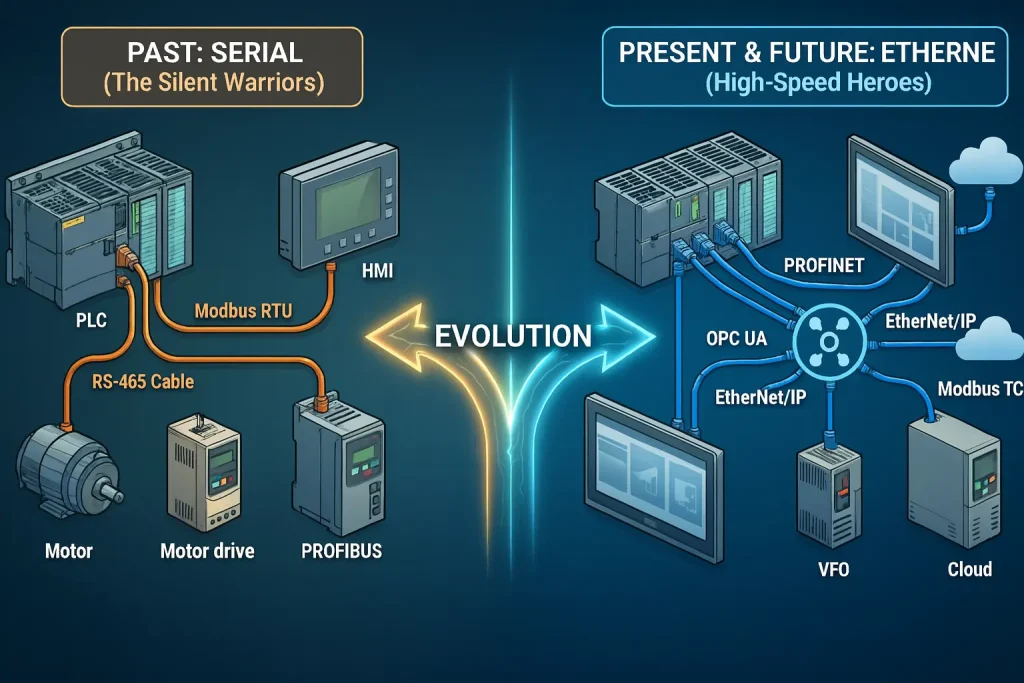
1. Serial Protocols (The Silent Warriors)
Earlier, machines used serial communication like MODBUS RTU or PROFIBUS over RS-232 or RS-485 wiring. These systems are slower but extremely reliable. Many plants still use them because:
- They work over long distances without issues
- They are very stable in noisy industrial environments
- They require minimal setup
Think of these as the quiet heroes-slow but dependable.
2. Ethernet Protocols (High-Speed Heroes)
As factories needed faster and more scalable communication, Ethernet-based protocols came into play. These include:
- MODBUS TCP
- PROFINET
- EtherNet/IP
These protocols are:
- Fast enough for real-time control
- Scalable to add multiple devices on the same network
- Flexible enough to connect PLCs, HMIs, SCADA, VFDs, and more
Ethernet protocols are now the backbone of modern automation systems.
Choosing the Right Industrial Communication Protocol
Not all protocols are created equal. Each has a strength depending on the task. For example:
Imagine you want a PLC to send speed commands to a VFD:
- Case 1: Both devices support TCP/IP → Simply set IP addresses, connect LAN cables, and it works.
- Case 2: PLC supports MODBUS, VFD supports only MODBUS RTU → You need a gateway to connect them.
This is why checking compatibility before starting a project is critical. Choosing the wrong protocol can lead to delays, errors, or extra costs.
Practical Benefits of Protocols
Using the right protocol has real advantages:
- Reliable Communication – Commands reach devices correctly.
- Reduced Downtime – Devices talk without errors, reducing stoppages.
- Scalability – Easily add more machines to the network.
- Flexibility – Combine multiple protocols for hybrid networks.
For example, a plant may use MODBUS RTU for older machines and PROFINET for high-speed drives. A gateway ensures they all communicate seamlessly.
How Aknitech Helps
At Aknitech, we design industrial networks that work perfectly with your plant’s requirements. Our team specializes in:
- PLC Programming – Automate your machines with precision.
- HMI & SCADA Systems – Monitor operations in real-time.
- VFD & Motor Control Integration – Smooth operation with accurate speed control.
- Industrial Networking Solutions – MODBUS, PROFINET, and EtherNet/IP setups for reliable communication.
- System Upgrades – Modernizing legacy machines for high-speed communication.
We make sure your machines talk to each other seamlessly, increasing productivity and reducing errors.
Real-World Example
Consider a factory floor:
- Sensors send data to a PLC using MODBUS RTU
- PLC controls motors via PROFINET
- HMI displays real-time data using EtherNet/IP
- SCADA collects all data for reporting
By using the right combination of protocols, every machine works in harmony, making the plant more efficient and reducing the chance of errors.