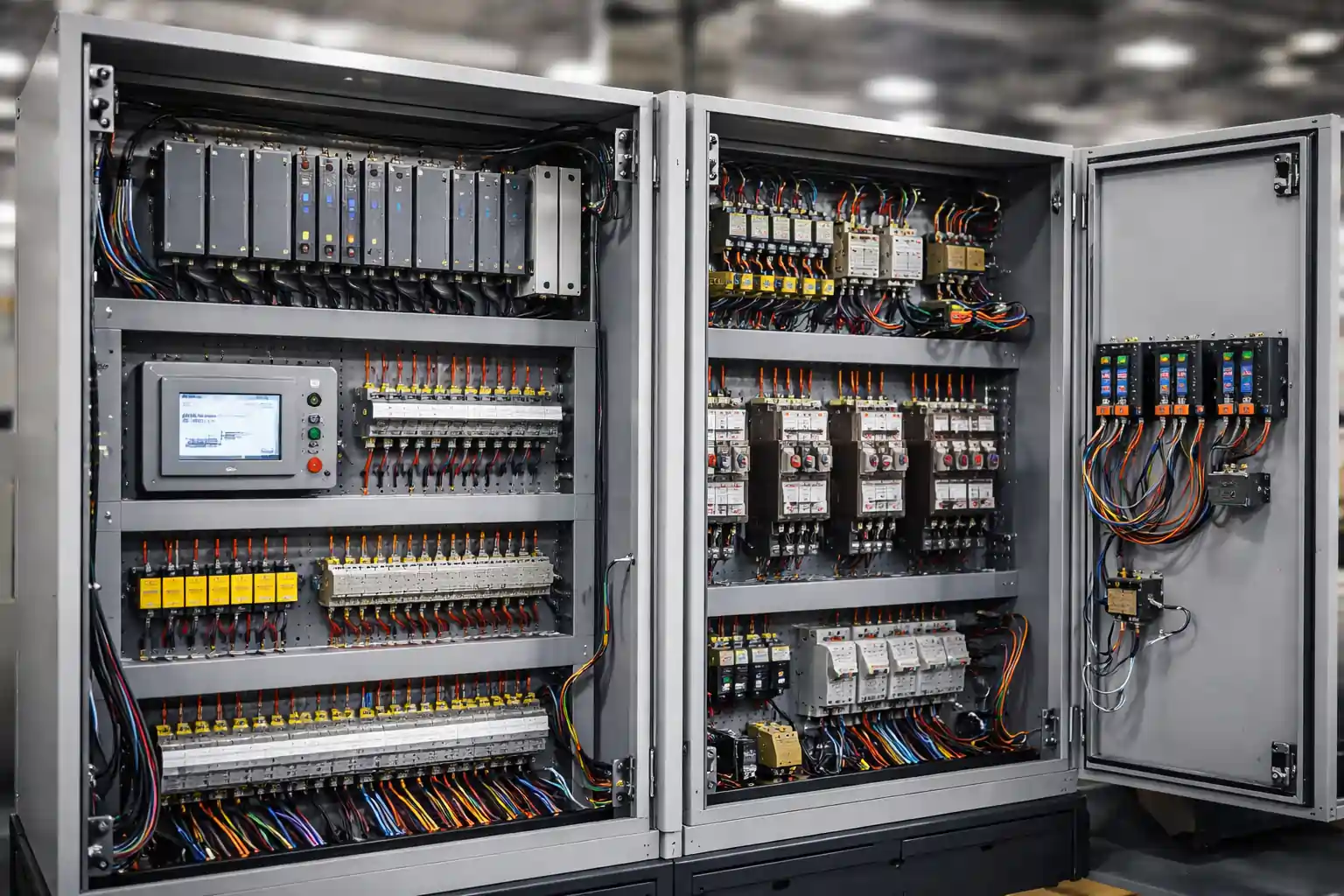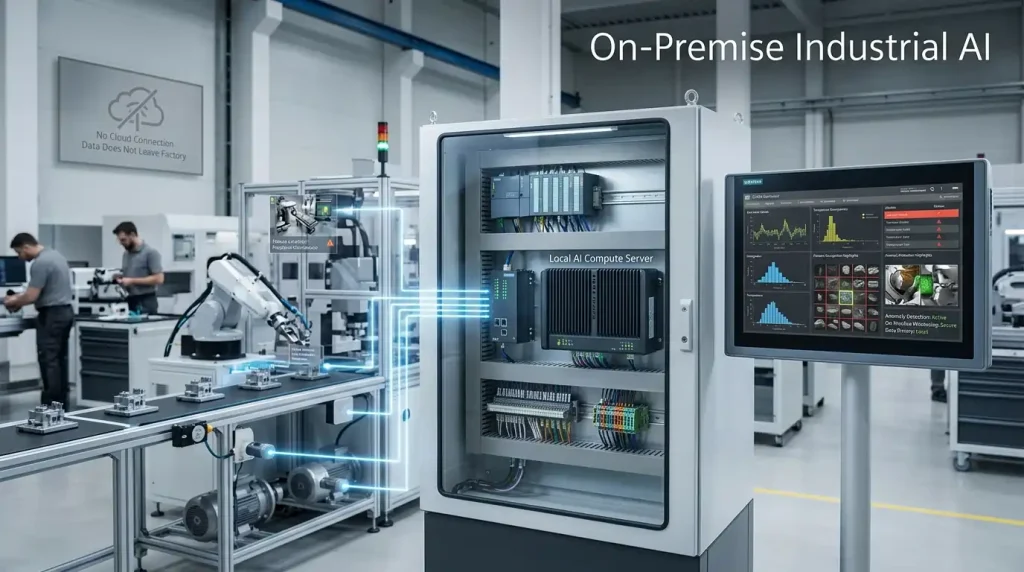
Let’s be honest. When someone in a plant manager’s chair hears the word “AI“, the first thought is rarely excitement. It’s usually – “Where does my data go?” And that’s a fair question. Most AI tools today are built around the cloud. You send data up, processing happens somewhere on a server far away, and results come back. Simple enough for a mobile app. But for a running production line in Bhopal, Mandideep, or a pharmaceutical unit in Dewas – this model creates real problems. The good news? Factories no longer have to choose between using AI and keeping their data secure. On-premise industrial AI has changed the game entirely. This blog breaks down what it is, how it works, which industries are already using it, and what it actually costs.
What Is On-Premise Industrial AI and Why Is It Different from Cloud AI?
On-premise industrial AI simply means the AI system runs inside your factory – on hardware that sits on your shop floor or in your server room – not on a third-party cloud platform. The data never leaves your facility. The AI model runs locally, processes in real-time, and gives outputs without needing an internet connection.
Cloud AI, by contrast, sends your factory’s sensor data, machine readings, and production numbers to an external server. That server does the analysis and sends results back. This round-trip takes time, requires a stable internet connection, and – most critically – means your operational data is sitting on someone else’s infrastructure.
What Is the Difference Between Edge AI and Cloud AI in Manufacturing?
Think of Edge AI as the local version of intelligence. When AI runs at the edge, it processes data right there, in real time, without routing it elsewhere. Here’s how the two approaches compare:
| Factor | Edge AI (On-Premise) | Cloud AI |
| Response time | Milliseconds – real-time | 200-500ms+ round trip |
| Data stays in the plant? | Yes – always | No – sent to external server |
| Works offline? | Yes – no internet needed | No – needs stable connection |
| Recurring cost | One-time hardware + setup | Monthly subscription fees |
| Best for | Real-time control, regulated industries | Model training, long-term analytics |
| Data privacy | Full control – your infrastructure | Depends on vendor’s policies |
How Does On-Device AI Inference Work Inside a Factory?
AI inference is the process of running a trained model to get predictions or decisions. On-device inference means this happens on a local computer, edge gateway, or industrial PC connected directly to your machines. The model has already been trained, and it now runs continuously on your floor, watching sensor signals, spotting anomalies, and flagging problems – all without touching the internet.
Also Read – Industrial Networking for Beginners: A Simple Guide to IT vs OT, Devices, and Protocol Families
Why Do Factories Avoid Cloud for AI Data Processing? Top Reasons
If you talk to plant engineers across India – especially in pharma, automotive, or steel – you’ll hear the same concerns come up again and again. Here are the real reasons factories are choosing to stay offline:
- Production data is valuable IP. Your cycle times, yields, and machine parameters represent years of process tuning. Sending them to a cloud vendor creates commercial and legal risk.
- Compliance restrictions. Regulated industries legally cannot send production data outside the facility – pharma, defence, and government contracts all have hard boundaries here.
- Unreliable connectivity. Industrial zones like Mandideep and Pithampur face periodic network disruptions. A cloud AI system goes blind the moment the connection drops.
- Latency is unacceptable. Real-time machine control cannot wait for a cloud round-trip of 200-500ms.
- Vendor lock-in risk. Once your data is on a cloud platform, switching providers becomes complicated and expensive.
- Ongoing subscription costs. Cloud AI platforms charge monthly or per-data-point fees that compound fast over a 3-5 year horizon.
Is Industrial Data Security and Data Sovereignty a Real Risk in the Cloud?
Yes, and it’s not theoretical. Data sovereignty means your data stays within the jurisdiction and control of your organisation. The moment it hits a cloud server – especially one hosted outside India – you lose that control. For industries with ISO, FDA compliance, or government contracts, this is not a grey area. It’s a hard boundary.
Why Industrial AI Latency Makes Real-Time Cloud Processing Impractical
Real-time factory automation doesn’t tolerate delays. A PLC responding to a pressure fault needs to act in under 50 milliseconds. Even a fast cloud round-trip takes 200 to 500ms. When you’re running a packaging line at 300 units per minute, or controlling a high-speed servo motor, that gap is not acceptable. Edge AI eliminates this completely – the decision happens on-site, in real time.
Also Read – PLC vs Relay Control System: Cost, Reliability & Automation Benefits Comparison
How to Use AI in a Factory Without Sending Data to the Cloud – Step by Step
Here’s the practical path. It’s simpler than most factory owners expect, especially when working with a team that already knows PLC systems, SCADA, and industrial networking.
- Identify the use case – Not every problem needs AI. Start with one – predictive maintenance on a critical motor, quality inspection on a line, or energy monitoring across a shift.
- Choose the right edge hardware – An industrial PC, IIoT gateway, or ruggedised edge server that handles your compute load without overheating in harsh factory conditions.
- Connect to your existing systems – Your PLC, HMI, or SCADA platform already collects the data you need. The AI layer sits on top, reading this data via MODBUS or OPC-UA protocols.
- Deploy the AI model locally – A pre-trained model is installed on the edge device. It runs continuously, analysing data and generating alerts without any cloud connection.
- Integrate outputs into your workflow – Alerts go to your HMI screen or SCADA dashboard. Reports feed into your MIS system. Your operators get better information without changing how they work.
How Does Predictive Maintenance AI Work Without Cloud?
Predictive maintenance AI monitors vibration, temperature, current draw, and noise patterns from motors and machines. It builds a baseline of normal behaviour and flags anomalies that signal early-stage failure – a bearing starting to wear, a belt losing tension, a pump cavitating. When it flags a problem, your maintenance team gets an alert three to seven days before the actual breakdown. No cloud subscription, no latency, no data leaving your facility.
Can PLC Systems Run AI Models Locally on the Shop Floor?
Directly on a PLC – no. PLCs are designed for deterministic logic, not heavy computation. However, a local industrial PC or edge AI gateway sitting alongside the PLC can handle the AI workload and communicate with it in real time. The PLC controls the machine. The AI layer watches, learns, and advises – feeding signals back into the PLC logic when action is needed.
How Does SCADA AI Integration Work in an Offline Factory Environment?
Modern SCADA platforms like AVEVA can be paired with local AI engines that analyse trends and flag process deviations. In an offline setup, the AI module runs on a server within the same local network as your SCADA system. It reads tag data, runs its models, and writes results back into the SCADA dashboard – all within your facility’s closed network.
Which Technologies Power Cloud-Free Industrial Automation with AI?
The combination of a few key technologies makes on-prem AI possible in any factory. Here are the core building blocks:
- Edge AI gateway or industrial PC – the compute hardware that runs the AI model locally.
- Industrial sensors – vibration sensors, thermal cameras, current transducers, pressure transmitters feeding real-time data.
- MODBUS / OPC-UA protocol stack – the communication layer connecting sensors, PLCs, and the AI system.
- Pre-trained AI model – trained for your specific use case (anomaly detection, quality inspection, energy monitoring).
- Local dashboard or SCADA integration – where operators see AI alerts and reports without any cloud dependency.
What Is an IIoT Edge Gateway and Which One Should Your Plant Use?
An IIoT edge gateway is a compact industrial computer that sits between your machines and your network. It collects data from sensors and PLCs, runs AI models locally, and communicates results to your control systems. Siemens, Advantech, and Dell offer industrial-grade gateways built for harsh environments. For most small to mid-sized plants in India, a mid-range gateway with a quad-core processor and 8GB RAM handles predictive maintenance and quality monitoring comfortably.
How Does Machine Vision Factory AI Run on Edge Hardware?
Machine vision factory AI uses cameras and image processing models to inspect products on the line – checking for defects, dimensional accuracy, label placement, or colour variations. On an edge setup, the camera feeds directly into a local GPU-equipped edge PC. The model runs frame-by-frame in real time and triggers a rejection signal if a defect is detected. Processing speed is typically 30 to 60 frames per second – fast enough for most packaging and assembly lines.
Where Can On-Premise AI Be Deployed Inside a Manufacturing Plant?
On-prem AI can be layered across the entire production process. The most impactful deployments happen where variability is highest and manual monitoring is most stretched:
- Production line quality inspection – real-time visual defect detection.
- Critical machine monitoring – motors, compressors, pumps, hydraulic systems.
- Energy management – shift-level consumption tracking and waste identification.
- Environmental monitoring – clean rooms, cold storage, temperature-critical processes.
- Conveyor and material handling systems – tension, speed, and jam detection.
- Packaging and labelling verification – label placement, fill level, seal integrity.
How AI Quality Control in Manufacturing Works on the Production Line
AI quality control replaces or supplements manual visual inspection. It’s faster, more consistent, and doesn’t suffer from fatigue at the end of a 12-hour shift. The AI quality control model is trained on images of accepted and rejected products. For plants making components for automotive or pharmaceutical customers, it also auto-generates inspection reports for MIS or ERP systems.
Where Is AI Anomaly Detection in a Plant Most Effective?
AI anomaly detection works best on equipment that runs continuously and where early failure signs are subtle – large motors, compressors, cooling systems, hydraulic units, and critical conveyors. The model monitors signatures 24 hours a day, catching patterns no shift engineer would notice – a 0.3°C temperature rise correlating with bearing wear, a 2% current increase signalling a lubrication issue.
Also Read – CT Shorting Link vs Neutral Disconnect Link: Safety, Testing, and Practical Use in Electrical Panels
Which Industries in India Are Already Using Local AI for Industry – Real Use Cases
On-prem industrial AI is not a future technology. It’s being used today across multiple sectors where data confidentiality and real-time response are non-negotiable.
AI Without Cloud for Automobile Manufacturing Plant – How It Works
Automobile plants were early adopters of Edge AI. Their production lines run at high speed with zero tolerance for quality escapes. Edge AI vision systems and predictive maintenance modules are now standard fixtures in Tier 1 and Tier 2 auto-component plants across Pune, Chennai, and the Pithampur industrial area near Bhopal.
Secure AI Deployment in Pharmaceutical Factory India – What to Know
For pharmaceutical plants, data integrity is a regulatory requirement. FDA 21 CFR Part 11 and Schedule M compliance require that production data be secure, traceable, and tamper-proof. Common AI applications in pharma plants include:
- Environmental monitoring in clean rooms – temperature and humidity anomaly detection.
- Tablet press fault detection – catching compression force deviations before bad batches are produced.
- Batch yield optimisation – AI analysis of process parameters to maximise output.
- Automated audit trail generation – compliant documentation produced locally, no cloud involved.
How Steel Plant Predictive Maintenance AI and Cement Plants Are Going Offline-First
Ruggedised edge AI hardware has made deployment possible even in harsh steel and cement environments. Several plants in Madhya Pradesh and Chhattisgarh now run offline AI systems on rolling mills and blast furnaces. In cement, a one-hour unplanned kiln shutdown can cost more than the entire on-premise AI installation – making the ROI case almost immediate.
What Are the Key Benefits of On-Premise Industrial AI for Factories?
Whether you run a small auto-component plant or a large chemical facility, the benefits of on-premise industrial AI are consistent across sectors. Here’s what plants are actually experiencing after deployment:
| Benefit | What it means on the ground |
| Full data privacy | No production data leaves your premises – ever |
| Real-time response | Sub-50ms decisions – cloud latency eliminated |
| Reduced downtime | 40-70% fewer unplanned breakdowns in year 1 |
| Lower long-term cost | One-time investment – no recurring cloud fees |
| Works without internet | Unaffected by network outages or disruptions |
| Compliance-ready | Meets FDA, ISO, and government data rules locally |
| Fits existing setup | Layers onto your PLC, SCADA, HMI – no overhaul needed |
| Better quality output | AI inspection catches defects human eyes routinely miss |
| Predictive – not reactive | Alerts 3-7 days before a breakdown, not after |
| Scalable from day one | Start with one machine, expand to the full facility |
Plants that deploy on-prem AI report an average 43% reduction in unplanned maintenance costs within the first 12 months, based on field data from industrial automation deployments across India.
What Are the Real Challenges of Implementing On-Premise Industrial AI?
Every technology has trade-offs. On-prem AI is powerful, but walking in with honest expectations makes the difference between a successful deployment and an expensive lesson. Here are the real challenges factories face – and how each one is typically handled.
| Challenge | Why it happens | How it’s typically solved |
| Upfront hardware cost | Edge servers, sensors, installation | Phased deployment – start with one machine |
| Model training & calibration | AI needs historical data to learn what’s normal | 3-6 weeks of baseline data collection before go-live |
| Integration with old machines | Legacy equipment lacks digital sensors or ports | Retrofit sensors + MODBUS adapters bridge the gap |
| False positive alerts | AI flags anomalies that aren’t real faults | Tuning period + threshold adjustment in first 30 days |
| Skilled support availability | On-prem AI needs local expertise to maintain | Choose a local partner with on-site support capability |
| Operator buy-in | Floor teams may distrust AI alerts initially | Start with non-critical use cases to build confidence |
| Data quality from sensors | Dirty or inconsistent sensor data breaks AI accuracy | Sensor audit + data cleaning before model deployment |
None of these challenges are deal-breakers. Every one of them is well-understood by experienced industrial automation teams. The key is choosing a partner who has solved them before – not someone learning on your shop floor.
Plant manager insight: The most common reason on-prem AI deployments underperform is poor sensor data quality, not a weak AI model. Always audit your sensors before deploying any AI layer.
What Opportunities Does On-Premise Industrial AI Open Up for Indian Factories?
India’s manufacturing sector is at a genuine inflection point. The combination of Industry 4.0, the PLI scheme push, rising export quality standards, and falling edge hardware costs has created a rare window. Factories that move now will have a 3-5 year head start on competitors who are still debating whether AI is “ready” for the shop floor.
Here is where the real opportunities lie:
- Predictive maintenance as a competitive advantage. Plants with zero unplanned downtime can promise customers shorter lead times and higher on-time delivery rates – a direct commercial edge.
- Export quality compliance without extra cost. AI-driven quality documentation satisfies international buyer audits automatically, reducing the cost and effort of quality certifications.
- Energy cost reduction in a high-tariff environment. With industrial electricity costs rising, AI energy management that cuts consumption 8-15% per shift compounds into significant annual savings.
- Skill gap mitigation. India faces a shortage of skilled maintenance engineers. AI-assisted monitoring means a smaller, less-specialised team can manage more machines with better outcomes.
- IIoT readiness as a stepping stone. On-prem AI is the foundation layer for full IIoT transformation – plants that deploy edge AI now are positioned to add connected MES, ERP integration, and digital twins in the next phase.
- New service revenue for OEMs and panel manufacturers. Electrical panel manufacturers and automation companies (like AKNItech) can now offer AI-enhanced products – PLC panels with built-in edge AI capability – as premium offerings.
- Government and PSU contracts. Public sector contracts increasingly require data sovereignty compliance. Factories with proven on-prem AI infrastructure have a documentation advantage in these tenders.
| Opportunity area | Who benefits most | Impact level |
| Predictive maintenance | Auto, steel, cement, pharma plants | Very High |
| Quality AI inspection | Export-facing manufacturers | Very High |
| Energy optimisation | Heavy industry, 3-shift operations | High |
| IIoT platform readiness | SMEs planning Industry 4.0 roadmap | High |
| PSU & govt compliance edge | Suppliers to government projects | Medium-High |
| AI-enhanced product offerings | Panel manufacturers, OEMs, automation cos. | Medium-High |
The window is open now. Edge AI hardware costs have dropped over 60% in the last three years. The factories that deploy in 2025-2026 will be benchmarking their competitors by 2028.
Who Should Choose On-Premise AI for Manufacturing and When Is the Right Time?
On-prem AI makes the most sense when one or more of these conditions apply to your plant:
- You handle sensitive process data or proprietary manufacturing formulas.
- Your industry has compliance requirements restricting data transfer – pharma, defence, food safety.
- Internet connectivity at your facility is unreliable or restricted.
- You run automation where millisecond response time matters.
- You already have PLC-based panels with SCADA – the data infrastructure is ready.
- You want a one-time investment without ongoing cloud subscription costs.
Is On-Premise AI Better than Cloud AI for Factories – Small Plants vs Large Plants
For large plants, a hybrid approach works well – cloud handles model training and long-term trend analysis, while on-prem AI handles real-time decisions. For small and mid-sized plants – the majority of Indian manufacturing – on-prem is usually the better fit. One-time hardware cost, no recurring fees, and uninterrupted operation even during network outages.
When Should SME Manufacturing India Start Investing in Affordable AI?
Earlier than most SMEs think. Entry-level edge AI systems for predictive maintenance start at affordable price points, and the payback period – measured in preventing breakdowns and reduced energy costs – is typically under 18 months. The right time to start is when you have one critical machine whose downtime hurts the most. Start there. Prove the value. Then expand.
Also Read – Analog Scaling in PLC (S7-200 Smart): Practical Explanation for Beginners
How Much Does On-Premise AI Cost for a Factory in India?
Here’s a realistic cost breakdown by deployment size:
| Deployment type | Scope | Approx. cost (INR) | Typical ROI period |
| Starter | Predictive maintenance, 3-5 machines | ₹3 – ₹8 lakhs | 10-14 months |
| Mid-range | Quality inspection + energy monitoring | ₹8 – ₹18 lakhs | 12-18 months |
| Full facility | End-to-end AI across production, QC, energy | ₹18 – ₹40 lakhs | 18-24 months |
| Custom IIoT + SCADA + AI | Full integration with existing SCADA/MES/ERP | Project-based quote | Varies by scope |
Compare that to the cost of one major unplanned breakdown – replacement parts, lost production, overtime wages – and the numbers look very different.
How to Reduce Factory Downtime Using AI on Edge and Measure ROI
Track these three numbers before and after deployment:
- Average breakdown frequency per month – how often unplanned stops happen.
- Average breakdown duration – how long each stop takes to resolve.
- Energy consumption per shift – baseline vs AI-optimised operation.
In most plants, edge AI for predictive maintenance reduces unplanned breakdowns by 40 to 70% within the first year. Pair AI alerts with your existing SCADA or HMI so operators respond fast – the faster the human response, the greater the downtime reduction.
Pro tip: Log every AI alert and its outcome for the first three months. This data is your best proof-of-value report – for your own team and for any future budget approvals.
Looking for an Industrial AI Company in Bhopal, Madhya Pradesh? Here Is What to Expect
When evaluating an industrial AI partner, check for:
- Hands-on experience with PLC brands your plant uses – Siemens, Allen-Bradley, Schneider.
- Knowledge of industrial protocols – MODBUS, OPC-UA, Profibus, Ethernet/IP.
- Proven SCADA integration work – not just software demos, but real commissioning experience.
- A calibration process for false positives – every good AI deployment has a tuning phase.
- Local support availability – on-site response for critical issues is non-negotiable.
How AKNItech Delivers On-Site AI Deployment for Manufacturing Plants in Central India
AKNItech, based in Bhopal, works with manufacturing plants across Madhya Pradesh to implement on-premise automation and AI-ready systems. The team brings together PLC programming, SCADA integration, HMI design, and industrial networking – which means AI can be layered onto existing systems rather than requiring a full overhaul.
The approach is practical: start with an audit of your current automation setup, identify the highest-value AI use case, deploy a contained pilot, and then scale.
Which Mandideep, Pithampur and Dewas Industrial Area Plants Have Already Adopted Edge AI?
Several manufacturing units in the Mandideep industrial area and Pithampur corridor have already deployed edge AI for predictive maintenance and energy monitoring. If your facility is in the Bhopal, Dewas, or Indore industrial belt, the infrastructure and supplier ecosystem for on-prem AI deployment is closer than you think.
How to Implement AI in Your Factory with Full Data Privacy – Your Next Steps
Here’s a simple starting framework:
- Pick one machine. The one whose downtime hurts the most.
- Pick one pain point. Breakdowns, quality failures, or energy waste – choose the sharpest problem.
- Deploy a focused edge AI pilot. Run it for 90 days alongside your existing process.
- Measure the difference. Breakdown frequency, duration, and energy numbers before and after.
- Decide whether to expand. The data from the pilot tells you exactly where to go next.
No need for a data science team. No need to re-engineer your facility. No need to send a single byte of your production data to a cloud server. Industrial AI works best when it’s built into the factory environment by people who actually understand how factories work – not just how algorithms work.
Get a Free Consultation for AI Factory Solution India – Contact AKNItech Today
If you’re in central India and want to explore what on-premise industrial AI can do for your plant – automotive, pharma, steel, food processing, or any other manufacturing sector – AKNItech is ready to walk through your setup and identify where AI can deliver the most immediate value.
No clouds. No data risk. No unnecessary complexity. Just practical automation intelligence, built for the shop floor. AKNItech – Plot No. 407/2, Barkheda Pathani, Bhopal, MP
+91-7389942094 | +91-7400726548
kapil@aknitech.in
www.aknitech.in
Written by the AKNItech Engineering Team | Bhopal, Madhya Pradesh, India | aknitech.in