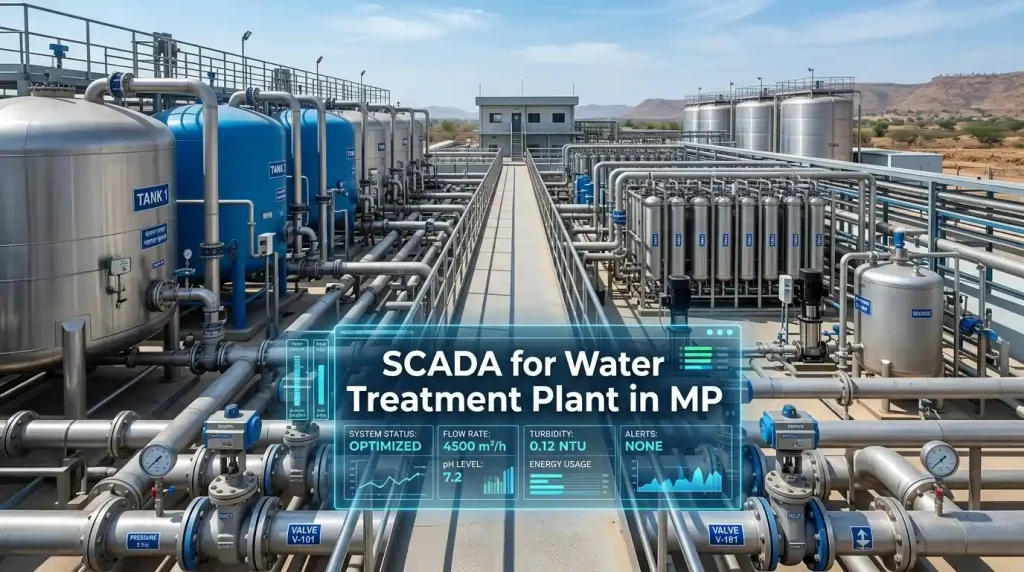
Water is life. But managing water – treating it, distributing it, monitoring its quality – has never been easy. For years, operators across Madhya Pradesh have relied on manual checks, paper logs, and guesswork to run water treatment plants. That era is changing fast. Today, SCADA for water treatment plant in MP operations is no longer a luxury. It is becoming a necessity. Municipal bodies in Bhopal, Indore, and Jabalpur are adopting automation. Industries in pharma, food processing, and chemicals are following the same path. The goal is simple – less downtime, better water quality, and full control from anywhere.
This blog covers everything. What SCADA for water treatment plant systems are, how they work, why MP is adopting them now, and what the real benefits look like on the ground.
What Is SCADA for Water Treatment Plant – And Why It Matters Now
Before getting into the details, it helps to understand what this technology actually does.
What Does a SCADA System Actually Do in a Water Plant?
SCADA stands for Supervisory Control and Data Acquisition. In simple terms, it is a software and hardware system that collects real-time data from sensors and equipment spread across a plant. That data is then displayed on a central screen, where operators can monitor everything and take action when needed.
In a SCADA for water treatment plant setup, the system keeps an eye on pumps, valves, chemical dosing units, flow meters, pH sensors, turbidity sensors, and more. All of this happens automatically, 24 hours a day, 7 days a week.
So instead of a worker walking to each pump every few hours to check its status, the SCADA system sends that information directly to a control room – or even to a mobile phone.
Also read – Why VFD Panel Failure in Summer India Spikes Every Year – What Every Plant Engineer Must Know
Did You Know? A single water treatment plant can have over 200 monitoring points. Without automation, tracking all of them manually would need a team working in shifts around the clock. With SCADA for water treatment plant, one operator can manage all 200 points from a single screen.
What Is HMI SCADA – And How Are Both Used Together?
HMI SCADA is a combination that is often misunderstood. Let us break it down clearly.
HMI (Human Machine Interface) is the screen or display through which an operator interacts with the machine. It shows live data, process graphics, alarms, and controls. SCADA, on the other hand, is the larger system – it collects data, stores it, sends alerts, and connects multiple PLCs and field devices.
Together, HMI SCADA gives operators a complete picture. The HMI shows what is happening right now. SCADA stores the history, sends reports, and allows remote access. When SCADA internet of things technology is added to this, the plant can be monitored from anywhere – a desktop, laptop, or even a smartphone.
Why Water Treatment Plants in MP Are Moving Towards Automation
The shift is not happening by accident. There are strong, practical reasons why water treatment plant automation Madhya Pradesh is picking up pace.
Why Manual Operations Are No Longer Enough for Municipal Water Supply
Think about how a municipal water plant used to work. Operators would check chlorine levels by collecting water samples. Pump pressures were noted down on paper. If a pump failed at 2 AM, someone had to physically go to the site to restart it.
This approach worked when cities were smaller and demand was lower. But today, cities like Bhopal and Indore have grown fast. Water demand has gone up. The number of pumping stations has increased. Maintaining quality while managing a growing network is no longer possible with manual methods alone.
How are municipal bodies using automation in water supply? In Madhya Pradesh, many urban local bodies are now installing SCADA-based control systems under smart city and Amrit 2.0 projects. These systems connect all pumping stations, reservoirs, and treatment units to a central control room. Operators can see the entire network on one screen and respond to problems in minutes – not hours.
Why Industries in MP Cannot Afford Downtime in Water Treatment
For industries, water treatment is not just about clean water. It is about production continuity. A pharmaceutical plant, for example, needs purified water for every batch it produces. If the water treatment system fails, the entire production line stops.
That is why industrial water plant automation company Bhopal providers like Aknitech are seeing growing demand from manufacturing sectors. Automation reduces the risk of human error, catches problems before they become breakdowns, and keeps the plant running without surprises.
Also Read – Why SCADA and IoT Skills in Factories Are More Important Than Coding
How SCADA System Works in a Water Treatment Plant – Step by Step
Understanding the working process helps in making the right decision about automation. Here is a straightforward explanation.
How PLC Logic Controls Pumps, Valves & Dosing in Real Time
At the heart of every automated water plant is a PLC – Programmable Logic Controller. This is a small but powerful industrial computer. It receives signals from sensors in the field, processes them based on pre-written logic, and then sends commands to actuators like pumps and valves.
For example, when a water level sensor in a tank sends a low-level signal, the PLC automatically starts the inlet pump. When the tank is full, the pump is stopped. This entire sequence happens without any human input.
In a PLC SCADA solution for water treatment, the PLC handles the fast, real-time control. The SCADA system handles the monitoring, reporting, and remote access. They work as a team.
A PLC based water treatment monitoring system can manage:
- Raw water intake pumps
- Chemical dosing (chlorine, alum, lime)
- Filtration backwash cycles
- Clear water storage and distribution
- Flow measurement and billing data
How HMI SCADA Gives Operators Full Visual Control of the Process
Once the PLC is doing the fieldwork, the HMI SCADA system brings all that information to the operator’s screen in a visual format. Instead of reading raw numbers, the operator sees a graphic of the plant – tanks filling up, pumps running or stopped, valves open or closed – all in real time.
Alarms are a key feature. If a pump temperature rises too high or a chemical level drops below a safe limit, the HMI immediately shows a red alert. The operator can then act fast before anything goes wrong.
SCADA designing in Bhopal by experienced teams like Aknitech involves creating these screens carefully. Each screen is designed to match the actual process flow of the plant. This makes it easier for operators to understand and respond quickly.
How Remote Monitoring Is Made Possible via SCADA & IoT
This is where SCADA internet of things technology changes everything.
Traditional SCADA systems were confined to a local network. Operators could only access them from inside the control room. With IoT integration, data from the plant can now be sent over the internet to any device, anywhere.
A plant manager sitting at home can check pump status on a mobile app. An engineer in Bhopal can log into a remote plant in Sehore or Vidisha and diagnose a fault without traveling. This is what remote monitoring water plant India now looks like.
The IoT layer also allows for predictive maintenance. Sensors track vibration levels in pumps, temperature in motors, and current draw in VFDs. When any reading goes outside normal limits, the system raises an alert – before the equipment actually fails.
Did You Know? Plants using SCADA for water treatment plant with IoT monitoring have reported up to 40% reduction in unplanned downtime. Remote access alone saves 3-5 hours of travel time per fault call in rural MP locations.
Which SCADA Software Is Best for Water Treatment Plants in India?
Choosing the right software matters a great deal. The wrong choice leads to poor visibility, slow response times, and high maintenance costs.
Which Parameters Does SCADA Monitor in a Water Plant?
A good real time water quality monitoring SCADA system keeps track of more than just pump status. Here is a look at the key parameters that are typically monitored:
| Parameter | Sensor Type | Why It Matters |
| pH Level | pH Sensor | Ensures water is safe for consumption and treatment |
| Turbidity | Turbidity Sensor | Measures water clarity and filter efficiency |
| Chlorine Level | Residual Chlorine Analyser | Ensures disinfection standards are met |
| Flow Rate | Electromagnetic Flow Meter | Tracks distribution and detects leaks |
| Tank Level | Ultrasonic / Pressure Sensor | Prevents overflow or dry running |
| Pump Pressure | Pressure Transmitter | Ensures proper distribution pressure |
| Motor Temperature | Temperature Sensor | Prevents motor burnout |
| Power Consumption | Energy Meter | Helps in energy cost management |
All of these readings feed into the SCADA for water treatment plant in MP system continuously. Reports are generated automatically for daily, weekly, and monthly review.
Which SCADA Software Does Aknitech Use for Water Treatment Projects?
Aknitech works with industry-leading platforms for SCADA software in Bhopal projects. AVEVA System Platform (formerly Wonderware) is one of the primary choices. It is widely used across India for municipal and industrial water treatment due to its strong data handling, open connectivity, and reliable alarm management.
For smaller plants and budget-conscious projects, Aknitech also deploys cost-effective SCADA solutions that still offer full monitoring capability, remote access, and reporting features.
Every SCADA designing in Bhopal project by Aknitech starts with a detailed process understanding – the team studies the plant layout, identifies all control points, and then designs the SCADA screens to match the real-world flow.
Also Read – How SCADA + PLC Combination Solves Power Factor Problems
Where & Who Is Using Water Treatment Automation in Madhya Pradesh?
The adoption is happening across both public and private sectors. Let us look at where it is most visible.
Municipal Bodies – How Bhopal, Indore & Other MP Cities Are Automating Water Supply
Several municipal corporations in Madhya Pradesh have already moved towards centralized monitoring of their water supply networks. SCADA system for municipal water supply India is being pushed actively under central government schemes like AMRUT 2.0 and Smart Cities Mission.
In Bhopal, the water supply network covering thousands of connections has been gradually linked to automated monitoring systems. Pumping stations now report real-time flow and pressure data. Leakage is detected faster. Supply schedules are managed more accurately.
In Indore, known for its urban management track record, water distribution automation has helped reduce non-revenue water – the water that is treated and pumped but never billed due to leakage or theft.
How are municipal bodies using automation in water supply? The approach usually starts with SCADA installation at major pumping stations. Then it expands to reservoirs, distribution zones, and eventually individual pressure zones. The goal is a fully connected network where every litre of water is tracked.
Industries – Pharma, Food Processing & Chemical Plants Using PLC SCADA in MP
On the industrial side, the demand for industrial water plant automation company Bhopal services has grown strongly. Key sectors driving this include:
Pharmaceutical plants – These need ultra-pure water for production. Any contamination or quality deviation can invalidate an entire production batch. SCADA systems here monitor conductivity, TOC levels, and system sanitization cycles continuously.
Food and beverage industry – Water quality directly affects product quality. Automated dosing and real-time monitoring ensure consistency across production batches.
Chemical plants – Effluent treatment plants (ETPs) in chemical factories use PLC SCADA solution for water treatment to ensure that discharged water meets pollution control board standards.
When Should You Upgrade to SCADA – Right Time to Automate Your Water Plant
Not every plant is ready for full automation on day one. But there are clear signals that it is time to make the move.
When Is Manual Control Becoming a Risk – Warning Signs to Watch
Here are the situations where water treatment automation service provider MP companies like Aknitech are called in most often:
| Warning Sign | What It Means |
| Frequent pump failures | No predictive monitoring in place |
| Inconsistent water quality | Manual dosing is unreliable |
| High operator overtime costs | Too many manual checks needed |
| Delayed fault response | No remote access or alerts |
| Poor data records | No automated reporting system |
| Regulatory non-compliance notices | Parameters are going out of range undetected |
If your plant is showing two or more of these signs, the cost of NOT automating is already higher than the cost of putting in a SCADA for water treatment plant system.
Municipal water supply automation benefits become clear very quickly after installation. Operators report fewer emergencies, better water quality consistency, and significant reduction in overtime costs within the first six months.
Also Read – SCADA Trends 2026: What Indian Industries Must Prepare For
So, What Are the Real Benefits of SCADA in Water Treatment Plant?
By this point, the working of the system is clear. So let us talk about outcomes – what does your plant actually gain?
To Reduce Operational Costs – How SCADA Cuts Labour & Chemical Waste
What are the benefits of SCADA in water treatment? The most immediate one is cost reduction.
Chemical dosing – chlorine, alum, coagulants – is a major operational expense. In manual plants, dosing is often done in fixed quantities regardless of raw water quality variation. This leads to overdosing on good days and underdosing when raw water quality drops.
With SCADA for water treatment plant automation, dosing is tied directly to real-time water quality readings. The system adjusts chemical quantities automatically based on incoming turbidity, pH, and other parameters. The result is accurate dosing – chemicals are used only as much as needed.
Labour costs also come down. Routine monitoring tasks that once required three to four operators per shift can be managed by one operator with a SCADA system in place.
To Ensure Water Quality Compliance – Real Time Monitoring Role
Water quality regulations in India are getting stricter. The Bureau of Indian Standards (BIS) and state pollution control boards require treated water to meet specific parameters before it is distributed or discharged.
Real time water quality monitoring SCADA helps plants stay compliant at all times. Alarms are set for each parameter. If any reading crosses the permitted limit, the system alerts the operator immediately. This allows corrective action before non-compliant water reaches the distribution network.
For industries, this is especially important. A single compliance failure can result in heavy penalties or temporary shutdown orders.
To Enable Remote Access – IoT + SCADA Working Together
One of the biggest quality-of-life improvements that comes with SCADA internet of things integration is remote access. Engineers and managers are no longer tied to the control room.
Remote monitoring water plant India capability means a plant in a remote location – a tehsil town, a rural industrial estate – can be supervised by an expert sitting in Bhopal. Faults are diagnosed over a remote connection. Configuration changes can be made without travel. Emergency response time drops from hours to minutes.
This is especially valuable for MP, where many water treatment plants are located in areas that are difficult to access quickly.
Did You Know? In one Aknitech project, a water treatment plant in central MP was experiencing repeated pump failures due to a calibration issue in the VFD. With SCADA for water treatment plant remote access enabled, the issue was diagnosed and resolved in 45 minutes – without the engineer leaving the Bhopal office.
Frequently Asked Questions About SCADA for Water Treatment Plant
What Is SCADA System in Water Treatment Plant?
SCADA for water treatment plant is a combination of software, hardware, and communication systems that monitors and controls all processes in a water treatment facility. It collects data from sensors and field devices, displays it in real time, and allows operators to take control actions from a central screen or remotely.
How Are Municipal Bodies Using Automation in Water Supply?
Municipal bodies in Madhya Pradesh are using SCADA to centrally monitor pumping stations, reservoirs, and distribution networks. SCADA system for municipal water supply India enables these bodies to track water flow, pressure, and quality across the entire network from a single control room – reducing response time for faults and improving service reliability.
What Are the Benefits of SCADA in Water Treatment?
The key benefits include reduced chemical and labour costs, better water quality compliance, faster fault detection, remote monitoring capability, and automated reporting. Plants that install SCADA for water treatment plant systems typically see measurable improvements within the first few months of operation.
Which SCADA Software Is Used in Water Plants in India?
Several platforms are used across India, including AVEVA System Platform, Ignition by Inductive Automation, and Siemens WinCC. For projects in Madhya Pradesh, SCADA software in Bhopal providers like Aknitech recommend platforms based on plant size, budget, and connectivity requirements.
How Does IoT Improve Water Treatment Plant Automation?
SCADA internet of things integration allows plant data to be accessed over the internet from any device. IoT sensors add predictive maintenance capability – tracking equipment health parameters and raising alerts before failures occur. This significantly reduces unplanned downtime and extends equipment life.
Why Aknitech Is the Right Partner for SCADA Designing in Bhopal & MP
Choosing a technology partner is as important as choosing the technology itself. Aknitech brings over a decade of hands-on experience in industrial water plant automation company Bhopal projects. The team has worked with municipal bodies, pharmaceutical plants, food processors, and chemical industries across Madhya Pradesh.
Every project starts with a thorough site study. Process flow is understood in detail. SCADA screens are designed to match the actual plant layout. PLC logic is written, tested, and commissioned on-site. Post-installation support is provided to ensure operators are fully trained and comfortable.
Aknitech is an authorised partner for AVEVA SCADA software – the same platform trusted by water utilities across India and globally. This means clients get not just implementation, but also software licensing, training, and long-term support from a single partner.
SCADA designing in Bhopal done right is not just about putting screens up. It is about building a system your operators trust, your managers rely on, and your regulators are satisfied with.
Water treatment automation service provider MP services from Aknitech cover the full project lifecycle:
- Site assessment and process mapping
- PLC logic development and panel fabrication
- HMI and SCADA screen design
- Field wiring and installation
- Commissioning and operator training
- Annual maintenance contracts
Ready to Automate Your Water Treatment Plant?
If you are a municipal body, plant manager, or industrial operator in Madhya Pradesh looking to upgrade to SCADA for water treatment plant, the right time to start is now. Every month of delayed automation is a month of unnecessary costs, quality risks, and missed compliance deadlines.
Aknitech is ready to help.
Whether you need a complete new automation system or want to upgrade your existing setup, our engineers will assess your plant, understand your requirements, and design a solution that fits your budget and goals.Call us today: +91-07389942094 | +91-7400726548
Email: kapil@aknitech.in
Visit: Plot No. 407, Adharshila, Barkheda Pathani, Bhopal, MP – 462022
Or fill the Request Callback form on our website – our team will reach you within one business day.