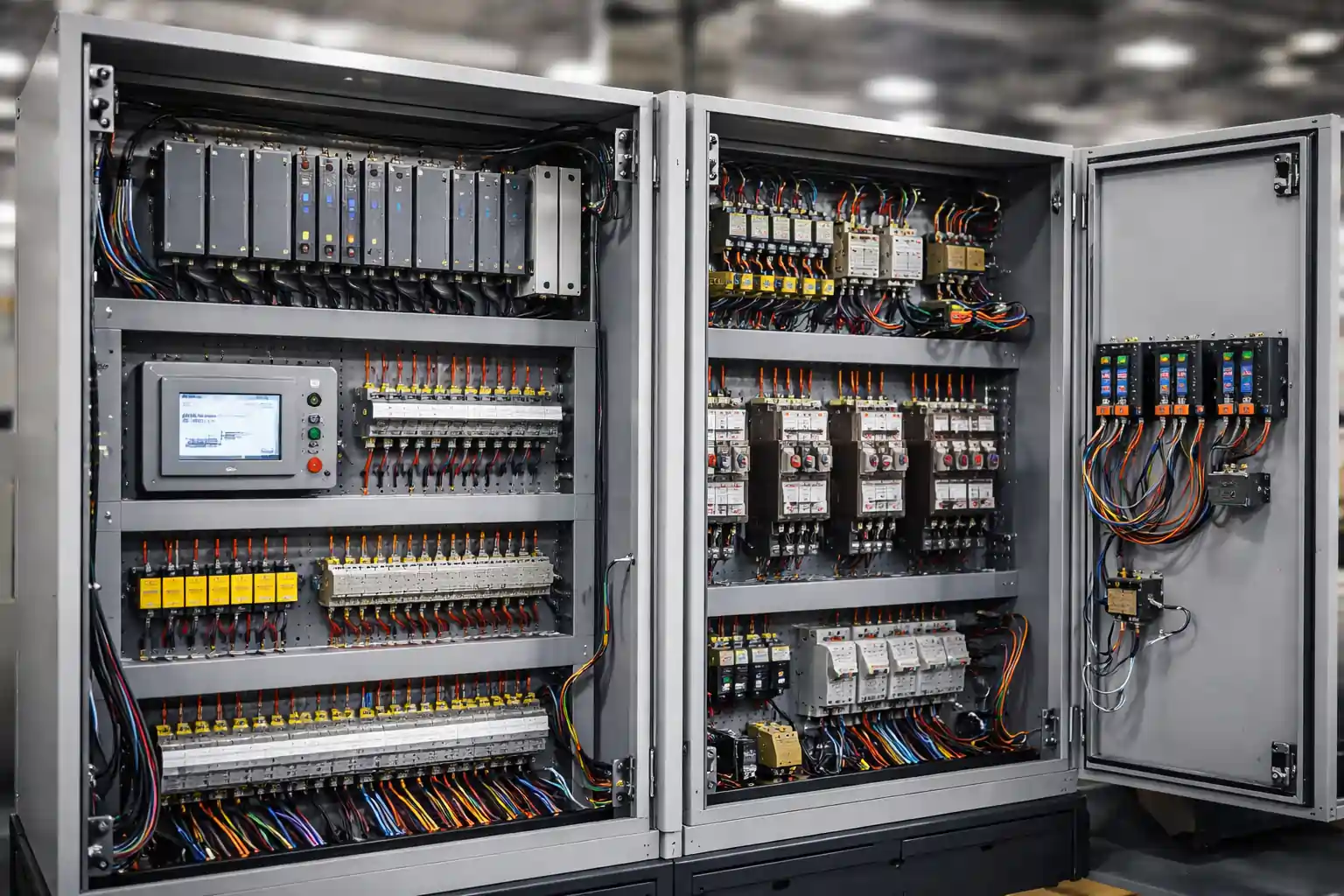
In any modern plant, automation is only as strong as its communication network. Machines may look powerful from the outside, but behind smooth production there is a silent system doing the real coordination: industrial networking.
This is where PLCs, HMIs, VFDs, sensors, remote I/O, and SCADA systems stay connected and exchange signals in real time. When the network is planned well, the plant runs smoothly. When the network is weak, even a good automation system can suffer from downtime, communication loss, and difficult troubleshooting.
That is why industrial networking for automation is not just about connecting wires. It is about building a communication structure that is stable, organized, scalable, and ready for real factory conditions.
At Aknitech, we understand that real industrial environments are very different from textbook diagrams. On paper, network layouts look simple. In a plant, every wire route, every topology choice, and every grounding decision can affect performance. This is why proper planning matters from day one.
What Is Industrial Networking in Automation?
Industrial networking is the method used to connect automation devices so they can share data and work together. These devices may include:
1. PLCs
PLCs are the main controllers in an automation system. They receive input signals, process the logic, and send output commands to keep machines and processes running properly.
2. HMIs
HMIs help operators interact with machines through a visual screen. They show process data, alarms, status updates, and allow users to control system functions more easily.
3. SCADA Systems
SCADA systems are used for monitoring and controlling large industrial processes from a central location. They collect real-time data, display trends, and help operators manage the full plant more effectively.
4. VFDs and Servo Drives
VFDs and servo drives control motor speed, movement, and performance in industrial applications. They improve efficiency, support accurate control, and help machines operate more smoothly.
5. Sensors and Transmitters
Sensors and transmitters detect physical values such as pressure, temperature, level, or flow and send that information to the control system. They are important for accurate monitoring and automation decisions.
6. Remote I/O Stations
Remote I/O stations help connect field devices to the control system when direct wiring is not practical. They reduce panel wiring, improve installation flexibility, and support better network-based communication.
7. Industrial PCs
Industrial PCs are rugged computers designed for factory and process environments. They are often used for data logging, visualization, advanced control tasks, and industrial software applications.
8. Ethernet Switches
Ethernet switches connect multiple automation devices within an industrial communication network. They help manage data flow between PLCs, HMIs, SCADA systems, and other connected equipment.
In simple words, industrial networking allows machines and control systems to “talk” to each other.This communication helps in many important tasks, such as monitoring process values, sending control commands, collecting machine data, triggering alarms, and keeping the whole system synchronized.
Without a reliable industrial communication network, the automation system becomes slow, unstable, or difficult to manage.
Why Industrial Network Design Matters in Real Factories
Many people think industrial communication is just about choosing a cable and connecting devices. In reality, industrial network design is much more than that.
A factory network must be planned with practical questions in mind:
- How quickly can a fault be detected?
- How long can the system stay online during a cable break?
- How easy will troubleshooting be?
- Can the network be expanded later?
- Will EMI affect communication quality?
- Is the layout suitable for the machine arrangement?
These questions are very important because factories need uptime. A few minutes of communication failure can stop production, create alarm conditions, or affect process accuracy.
That is why industrial networking should always be planned based on actual plant conditions, not just theory.
Common Network Topologies Used in Industrial Automation
In automation systems, topology means the way devices are physically and logically connected. Different topologies are used depending on plant size, budget, criticality, and expansion needs.
Let us look at the most important ones.
Ring Topology: A Reliable Choice for Critical Plants
Ring topology is one of the most preferred structures in industrial automation, especially where high availability is important.
In this setup, devices are connected in a circular communication path. But in real industrial applications, companies usually do not use a simple ring. They use MRP ring topology.
MRP stands for Media Redundancy Protocol. Its main benefit is redundancy. If one communication cable breaks, the network quickly switches to another route. This recovery happens in milliseconds, which helps the system stay online with minimum interruption.
This is why MRP ring is a strong choice for:
- critical automation systems
- process plants
- production lines that need high uptime
- systems where communication loss is costly
The biggest advantage of ring topology in industrial Ethernet is fault tolerance. Instead of complete network failure, the system can continue communication through an alternate path.
For industries where downtime directly impacts production, this topology is often worth the investment.
Bus Topology: Simple, Practical, and Cost-Effective
Bus topology is one of the most commonly used network layouts on the factory floor. It is simple, cost-effective, and works well when devices are arranged in a line or sequence.
In many machine-level applications, bus topology fits naturally because equipment is installed according to process flow. This makes cable routing easier and keeps the network organized.
However, one important point must always be remembered: termination matters.
The last device in the bus network should have a termination resistor. This helps stabilize communication and prevents signal reflection. Without proper termination, the network may become unstable, and devices can face communication errors.
That is why even a simple bus topology needs correct implementation. A small installation mistake can create major communication issues later.
Bus topology is often a good choice when:
- machine layout is linear
- budget is limited
- communication distance is manageable
- the system does not require advanced redundancy
It is simple, but it still needs proper engineering.
Hybrid Network Topology: Flexible for Modern Plants
Today’s plants often need something more flexible than a pure ring or pure bus structure. This is where hybrid topology becomes useful.
A common approach in modern automation is a star plus daisy chain or star plus bus design. In this setup, an industrial Ethernet switch acts as the center point, and smaller machine networks are connected around it.
This method helps create a well-organized communication structure for the full plant.
Why is it popular?
Because it offers a balance between flexibility, expansion, and practical wiring.
A hybrid network topology is helpful when:
- multiple machines are grouped in sections
- future expansion is expected
- centralized network management is needed
- plant layout is complex
This type of design makes it easier to extend the system later without disturbing the entire network. For growing factories, this is a major benefit.
Managed vs Unmanaged Switch in Industrial Networking
Industrial Ethernet switches are a very important part of network communication. They help connect multiple devices and manage traffic between them.
There are two main types:
Unmanaged Switch
An unmanaged switch handles basic switching tasks. It is simple and easy to use. In small systems, it can work well where advanced control is not needed.
It is usually best for:
- small automation setups
- simple machine communication
- low-complexity applications
The main benefit is simplicity. But it offers limited control.
Managed Switch
A managed switch gives much more control and visibility. It supports advanced features that help make the network more scalable, secure, and stable.
These features may include:
- VLAN support
- QoS
- network diagnostics
- redundancy support
- traffic control
- easier troubleshooting
In industrial automation, managed switches are preferred for larger and more critical systems because they make network monitoring and fault handling much better.
If a plant wants long-term reliability and easier maintenance, managed switches are usually the better choice.
Why Shielded Communication Cable Matters
Industrial environments are noisy. Motors, drives, panels, and power lines generate electrical noise that can disturb communication signals. This is why cable quality and shielding are very important. Using shielded cable helps protect the communication signal from EMI, or electromagnetic interference.
But there is one important rule: the shield should be grounded at only one point. If the shield is grounded at both ends, EMI-related issues can increase and communication may become unstable. This can create unnecessary signal disturbance and make troubleshooting difficult.
So the goal is not just to use shielded cable. The goal is to use it correctly.
Good industrial networking depends on both design and installation quality.
Communication Cable Routing: A Small Detail with Big Impact
One of the most ignored parts of industrial communication is cable routing.
In many plants, communication cables and power cables are carelessly routed together. This is a common mistake.
Power cables carry higher electrical energy and can create EMI. If communication cables are routed alongside them, signal quality may be affected. This can result in unstable communication, intermittent faults, or random data errors.
To reduce this risk:
- communication cable routes should be planned separately
- power and signal cables should not run together
- panel wiring should stay clean and organized
- grounding practices should be followed carefully
A clean network layout is not only good for signal performance. It also makes maintenance easier and improves the overall quality of the automation system.
Key Benefits of Proper Industrial Networking
When industrial networking is designed correctly, the benefits go far beyond communication alone.
A strong network can help with:
- better system uptime
- faster fault detection
- easier troubleshooting
- more stable PLC and SCADA communication
- improved machine coordination
- easier future expansion
- safer and cleaner cable management
- reduced downtime risk
In short, the network becomes the backbone of the plant.
That is why automation projects should never treat networking as an afterthought. It should be part of the planning from the start.
Best Practices for Industrial Network Design
A strong industrial automation network usually follows a few practical rules.
1. Choose topology based on plant need
Do not select a network layout only because it looks easy on paper. The right network topology should be chosen according to plant uptime needs, cable distance, machine placement, and future flexibility. A well-planned industrial network design improves communication stability and reduces faults.
2. Use managed switches for critical systems
In modern plants, managed switches are a better choice for systems that need more control and reliability. They support better diagnostics, traffic handling, and network monitoring, which makes the industrial Ethernet network more scalable and easier to troubleshoot.
3. Follow proper grounding rules
Correct shield grounding is very important for stable communication. If grounding is done the wrong way, it can create unwanted electrical noise and disturb signals. Good grounding practices help reduce EMI in industrial networking and improve overall network performance.
4. Keep communication and power routing separate
Communication cables and power cables should never be routed together without planning. Power lines can create interference that affects signal quality and causes unstable communication. Proper cable routing helps maintain a clean and reliable industrial communication network.
5. Plan for maintenance and future expansion
A good network should not only solve today’s requirement but also support tomorrow’s growth. When you plan for service access, fault tracing, and future device addition, the automation communication system becomes more practical, scalable, and cost-effective over time.
How Aknitech Supports Industrial Networking for Automation
At Aknitech, we believe that industrial networking should be practical, reliable, and built around real plant needs.
We do not see communication design as just wiring. We see it as a critical part of plant performance. From network topology selection to industrial panel integration, PLC communication, switch planning, and cable routing, every decision matters.
Whether a plant needs a simple machine-level network or a more advanced industrial Ethernet setup, the goal remains the same: stable automation communication with minimum downtime and easy maintenance.
FAQs
What is industrial networking in automation?
Industrial networking in automation is the system that connects PLCs, HMIs, SCADA, drives, sensors, and other devices so they can share data. It helps machines communicate in real time. This makes plant operations smoother, faster, and more reliable.
Why is industrial networking important in a factory?
Industrial networking is important because it supports stable machine communication and reduces downtime. A well-planned network helps in faster fault detection and easier troubleshooting. It also improves overall plant efficiency and control.
Which topology is best for industrial automation?
The best topology depends on plant layout, uptime needs, and budget. Ring topology is preferred for redundancy, while bus topology is often used for simple and cost-effective setups. Hybrid topology works well in modern plants that need flexibility and expansion.
What is ring topology in industrial automation?
Ring topology connects devices in a loop so communication can continue through another path if one cable fails. In industrial automation, MRP ring topology is commonly used for fast recovery. It is a reliable option for critical systems that need high uptime.
What is bus topology in industrial networking?
Bus topology connects devices along a single communication line, making it simple and affordable. It is commonly used on factory floors where machine placement is linear. Proper termination at the last device is important for stable communication.
Final Thoughts
Industrial networking for automation is the heartbeat behind modern plants. Every wire, every route, and every communication path plays a role in keeping production stable.
Textbook diagrams may show simple ring, bus, and star layouts, but real factories need much more careful planning. They need redundancy where required, clean cable routing, proper switch selection, stable grounding, and a network structure that supports real industrial conditions.
When industrial networking is designed well, automation becomes stronger, smarter, and easier to manage.
If your plant is planning a new automation system or upgrading an existing one, network design should be one of the first things to get right.