Manufacturing is changing fast. Rising labor cost, quality pressure, and tight delivery timelines are pushing industries toward smarter production methods. That is why companies are shifting from manual work to automation. But automation is not just one technology – there are different approaches. In this guide, you’ll clearly understand the types of automation systems and which one actually fits your factory.
What is an Automation System in Industry?
An automation system means using machines, sensors, PLCs, and software to control industrial processes with minimum human intervention.
In simple terms:
Instead of an operator running every step → the system runs the process automatically.
Industries adopt automation to:
- increase production speed
- reduce human error
- maintain consistent quality
- reduce manpower dependency
- monitor processes in real time
For example, a packaging plant where workers manually fill and seal boxes often faces uneven output and mistakes. After installing an Industrial Automation System using sensors and PLC control, production becomes stable and predictable.
This is why automation systems in the manufacturing industry are now considered a necessity rather than a luxury.
Classification of Automation Systems
Industrial automation is mainly divided into three categories:
| Automation Type | Production Nature | Flexibility |
| Fixed Automation | Mass production | Very Low |
| Programmable Automation | Batch production | Medium |
| Flexible Automation | Mixed production | High |
Understanding this classification of automation systems helps businesses choose the right investment instead of overspending or under-automating.
1. Fixed Automation System (Hard Automation)
Fixed automation is designed for one specific task that runs continuously with minimal variation.
How Fixed Automation Works
Machines are mechanically configured for a single operation sequence. The process rarely changes, and the production line runs repeatedly at high speed.
Once installed, changing the product design is difficult and expensive.
Real Industry Examples
- Automobile assembly lines
- Bottle filling plants
- Cement bag packing lines
- Conveyor-based sorting systems
These are classic Automation Systems in Industry where the same product is produced every day.
Advantages
- Very high production rate
- Lowest cost per unit
- Minimal operator intervention
- Reliable quality consistency
Limitations
- Almost zero flexibility
- High initial investment
- Not suitable for product variation
When Should You Use It
Best for:
- mass production factories
- stable demand products
- long production lifecycle items
If your product rarely changes and demand is continuous, fixed automation is the most economical solution.
2. Programmable Automation System
Programmable automation is used when products change in batches but not continuously.
Working Principle
The machine operation is controlled through PLC programming.
When product design changes → program is updated → system produces a new batch.
This makes PLC Based Automation System extremely popular in medium-scale industries.
Industrial Applications
- CNC machining operations
- Batch chemical processing
- Food processing plants
- Pharmaceutical manufacturing
Here the same line produces different products at different times.
Advantages
- Product change possible through program modification
- Good production accuracy
- Suitable for medium production volume
- Lower cost than flexible automation
Limitations
- Production stops during changeover
- Requires skilled technician
- Not ideal for daily variation
Best Use Case
Batch manufacturing industries where products vary but not every hour.
Example: A factory producing 10 different sizes of components each week.
3. Flexible Automation System
Flexible automation is the most advanced among the types of automation systems. It allows production change with almost no downtime.
How It Operates
The system automatically adjusts settings using software logic, robotics, and sensors. Machines recognize the product and configure themselves.
No manual reprogramming is needed each time.
Where It Is Used
- Automotive component manufacturing
- Electronics assembly lines
- Smart factories
- Customized product manufacturing
Advantages
- Instant product changeover
- Very low human intervention
- High production efficiency
- Suitable for modern manufacturing
Limitations
- Highest investment cost
- Complex system integration
- Requires proper planning
Ideal Industries
Factories producing multiple variants daily benefit the most from flexible automation in manufacturing.
4. Integrated Automation System
Integrated automation is the highest level of industrial automation where all machines, software, and business systems communicate with each other in real time.
Here the factory does not run separate machines – it runs as one connected ecosystem.
How It Works
Every part of the plant is connected through an industrial network:
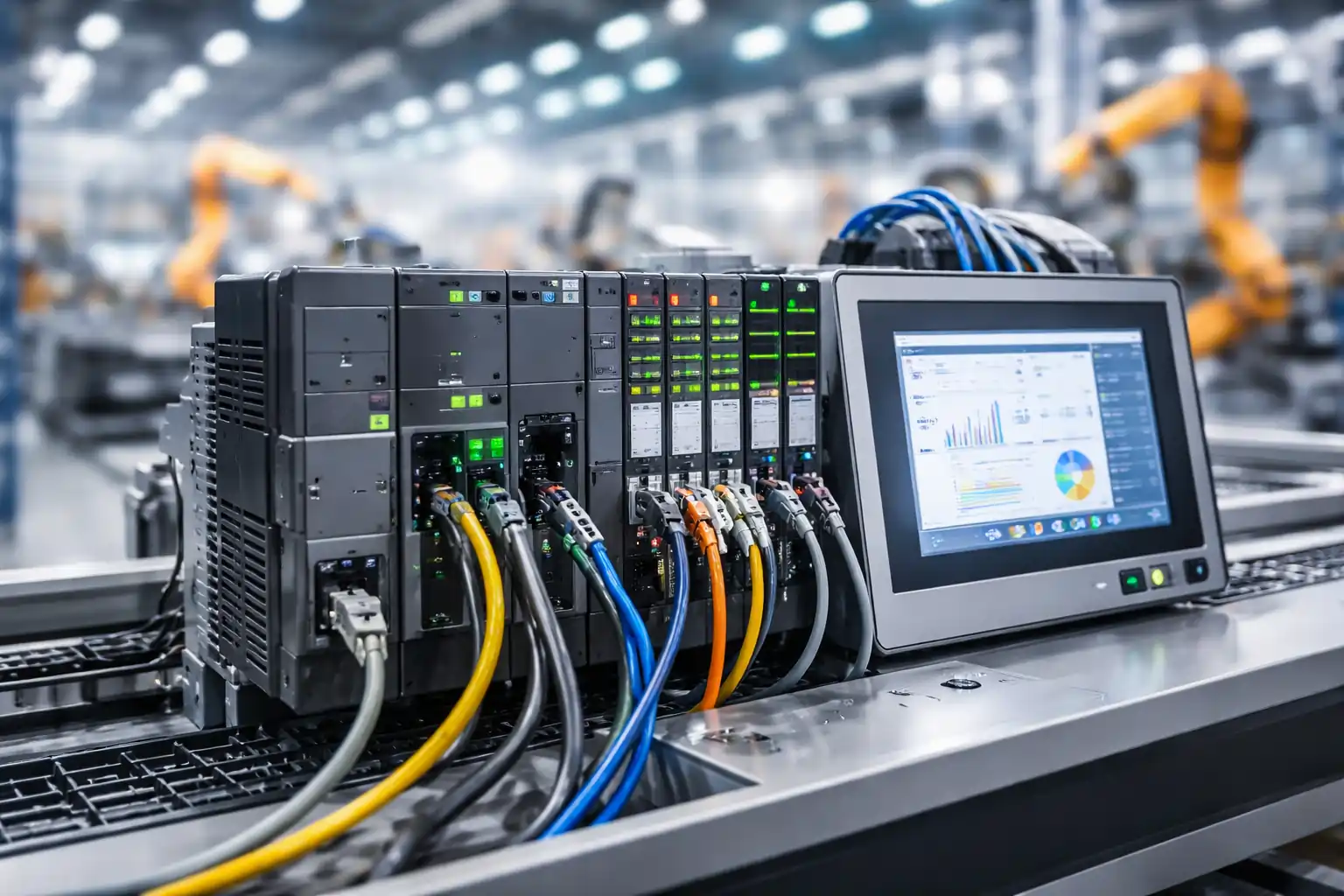
- PLC controls machines
- SCADA Monitors Production
- MES tracks manufacturing data
- ERP manages orders & inventory
All systems share data automatically.
Example:
When a customer order enters ERP → production schedule automatically updates → machines start production → quality data stored → dispatch planned.
No manual coordination required.
Real Industry Examples
- Smart factories (Industry 4.0 plants)
- Automotive manufacturing units
- Large FMCG production plants
- Pharmaceutical regulated industries
This is where Automation Systems in Manufacturing Industry become fully digital.
Advantages
- Complete production visibility
- Real-time decision making
- Predictive Maintenance Possible
- Minimum human dependency
- Maximum efficiency and traceability
Limitations
- Highest implementation cost
- Requires planning and system integration expertise
- Not suitable for very small factories initially
When Should You Use It
Best for industries that:
- run multiple production lines
- need traceability
- handle large order volumes
- want Industry 4.0 transformation
Integrated automation is usually implemented step-by-step after programmable or flexible automation.
Fixed vs Programmable vs Flexible Automation
| Factor | Fixed | Programmable | Flexible |
| Production Volume | Very High | Medium | Variable |
| Flexibility | Very Low | Medium | Very High |
| Changeover Time | Not possible | Minutes / Hours | Seconds |
| Cost | Medium | Medium-High | High |
| Skill Requirement | Low | Medium | High |
| Best Industry | Mass production | Batch production | Custom production |
This comparison helps answer a common question:
Which automation system is best for factory?
The answer depends on production type – not technology popularity.
How to Choose the Right Automation System for Your Factory
Before investing in automation solution for manufacturing plant, evaluate these points:
1. Production Pattern
- Same product daily → Fixed automation
- Batch variation → Programmable automation
- Frequent customization → Flexible automation
2. Budget
Higher flexibility always means higher cost.
Wrong selection increases ROI time.
3. Expansion Plan
If product variation may increase in future, avoid rigid systems.
4. Labor Dependency
If your plant struggles with manpower availability, automation becomes essential.
Choosing correctly prevents unnecessary upgrades later.
Benefits of Using Automation in Manufacturing
Industries adopt automation mainly for operational stability.
Key benefits:
- increase production using automation system
- reduce human error in manufacturing
- improve product consistency
- reduce downtime using automation
- improve worker safety
- Real-Time Production Monitoring
Many factories also notice reduced electricity waste because machines operate in optimized cycles.
When Industries Should Upgrade to Automation
Companies usually delay automation until problems become serious.
These are clear signals:
- production line slow and inconsistent
- high rejection rate
- frequent machine stoppage
- labor shortage
- rising operational cost
If these issues exist, manual production will always remain unpredictable.
Automation is not about replacing workers – it is about stabilizing output.
Conclusion
Understanding the types of automation systems – fixed, programmable, and flexible automation – helps industries make smarter investments. Each system solves a different production challenge. The best choice is not the most advanced one, but the one matching your manufacturing pattern.
Automation works best when planned according to real operational needs rather than trends.
Need Help Automating Your Plant?
If your factory is facing production delays, frequent errors, or manpower dependency, a properly designed automation system can solve it.
Aknitech Engineers analyze the process, suggest the right automation type, and implement a reliable solution suited to your production goals.
Frequently Asked Questions (FAQ)
1. What are the main types of automation systems?
There are three main types of automation systems: fixed automation, programmable automation, and flexible automation. Each is designed for different production needs – mass production, batch production, and customized production.
2. Which automation system is best for a small factory?
Most small and medium industries prefer programmable automation because it offers flexibility at a reasonable cost. It allows product changes without replacing machines.
3. What is the difference between fixed and flexible automation? Fixed automation runs
one product continuously with very high speed but no flexibility. Flexible automation can switch between multiple products quickly without stopping the production line.
4. Where is programmable automation used in industry?
Programmable automation is commonly used in CNC machining, food processing, pharmaceutical plants, and batch manufacturing where products change periodically.
5. Does automation reduce labor jobs?
Automation mainly changes the nature of work rather than removing jobs. It reduces repetitive manual tasks and increases the need for skilled operators and maintenance technicians.