
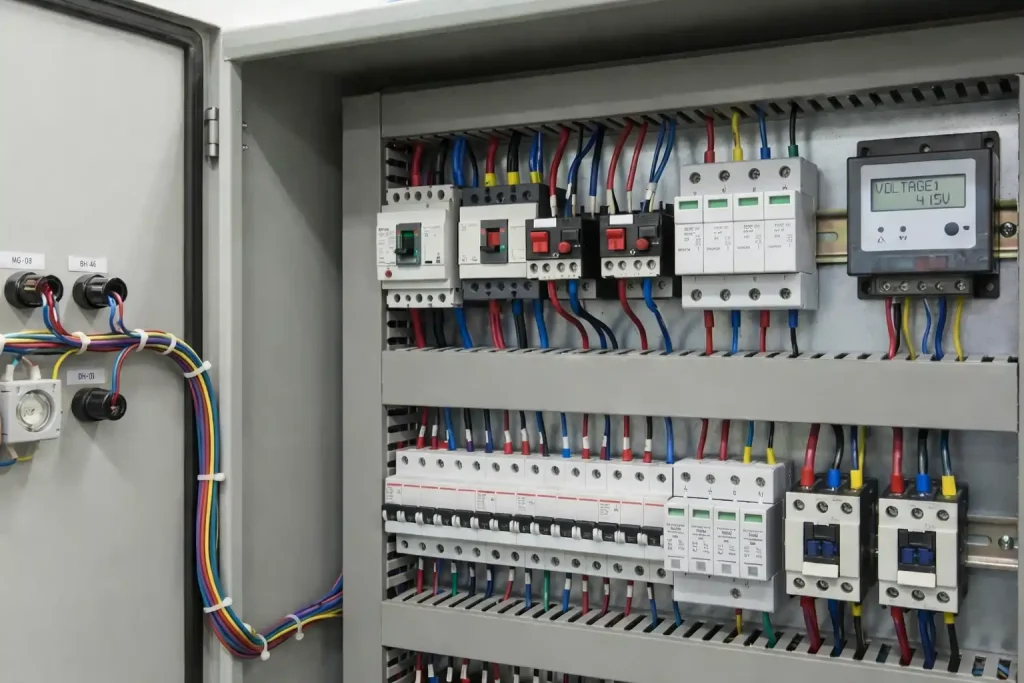
Motor Control Centre (MCC) panels play a critical role in controlling and protecting motors in industrial environments. From manufacturing plants to process industries, MCC panels ensure smooth motor operation, system reliability, and operator safety. However, the real strength of an MCC panel lies in the protection devices used inside it. These devices safeguard motors, equipment, and electrical systems from faults such as overloads, short circuits, voltage fluctuations, and earth faults. We will explore the essential protection devices used inside MCC panels, their functions, and why they are indispensable in modern industrial automation systems.
What Is an MCC Panel?
An MCC (Motor Control Centre) panel is a centralized electrical panel used to control and protect electric motors. It houses various control and protection components such as circuit breakers, relays, contactors, and monitoring devices.
MCC panels are commonly used in:
- Manufacturing plants
- Power plants
- Water treatment facilities
- Oil & gas industries
- Cement, steel, and chemical plants
The primary objective of an MCC panel is not just motor control, but motor protection and system safety.
Why Protection Devices Are Critical in MCC Panels
Industrial motors operate under heavy loads and harsh conditions. Without proper protection, even a small fault can lead to:
- Motor damage
- Equipment failure
- Production downtime
- Fire hazards
- Costly repairs
Protection devices inside MCC panels continuously monitor electrical parameters and isolate faulty circuits instantly, preventing damage and ensuring safe operation.
Types of Protection Devices Used Inside MCC Panels
Below are the most important and commonly used protection devices in MCC panels, each serving a specific purpose.
1. Miniature Circuit Breaker (MCB)
MCBs are basic protection devices used mainly for control circuits and small loads inside MCC panels.
Function of MCB:
- Protects against overload and short circuit
- Automatically trips when current exceeds safe limits
- Used in auxiliary and control circuits
Why MCB Is Important:
MCBs prevent damage to control wiring and instruments, ensuring uninterrupted panel operation.
2. Molded Case Circuit Breaker (MCCB)
MCCBs are heavy-duty protection devices used for main incomers and outgoing feeders in MCC panels.
Function of MCCB:
- Overload protection
- Short circuit protection
- Adjustable trip settings
- High breaking capacity
Industrial Benefit:
MCCBs can handle large motor currents and are ideal for protecting high-capacity motors in industrial MCC panels.
3. Overload Relay
Overload relays are specifically designed to protect motors from thermal overload conditions.
How It Works:
- Detects excess current drawn by the motor
- Trips the circuit when motor runs beyond rated load
- Prevents overheating and winding damage
Why It’s Essential:
Motors often face overload due to mechanical issues. Overload relays protect motors without interrupting normal startup currents.
4. Short Circuit Protection Devices
Short circuits are among the most dangerous electrical faults. MCC panels use a combination of devices to handle such situations.
Common Devices Used:
- MCCBs
- HRC fuses
- ACBs (in large systems)
Importance:
Short circuit protection devices isolate faults within milliseconds, preventing fire hazards and equipment destruction.
5. Earth Fault Relay (EFR)
Earth fault relays detect leakage current flowing to ground, which can be extremely dangerous.
Key Functions:
- Detects insulation failure
- Prevents electric shock
- Reduces fire risk
Why Earth Fault Protection Matters:
Even a minor earth leakage can cause serious accidents. EFRs are essential for industrial electrical safety compliance.
6. Phase Failure Relay
Industrial motors are designed to operate on balanced three-phase supply. Phase failure can cause severe motor damage.
Protection Offered:
- Detects loss of one or more phases
- Trips the motor circuit instantly
- Prevents single-phasing damage
Industrial Use Case:
Very common in plants with unstable power supply or frequent voltage interruptions.
7. Phase Sequence Relay
Incorrect phase sequence can cause motors to rotate in the wrong direction, leading to mechanical failures.
Role of Phase Sequence Relay:
- Detects incorrect phase order
- Prevents reverse rotation
- Protects pumps, conveyors, and compressors
This protection is especially critical in automation-driven processes.
8. Under Voltage and Over Voltage Relay
Voltage fluctuations are common in industrial power networks and can damage motors and control equipment.
Functions:
- Trips motor during low voltage conditions
- Protects equipment from overvoltage
- Prevents overheating and insulation failure
Benefit:
Ensures stable motor operation and extends equipment life.
9. Surge Protection Device (SPD)
Surges caused by lightning or switching operations can destroy sensitive electronics inside MCC panels.
SPD Protection:
- Diverts surge voltage to ground
- Protects PLCs, HMIs, and control circuits
- Reduces downtime caused by electronic failure
SPDs are especially important in PLC-based MCC panels.
10. Control Circuit Protection (Fuses & MCBs)
Control circuits power relays, timers, PLC inputs, and signaling devices.
Why Control Circuit Protection Is Needed:
- Prevents damage to sensitive components
- Ensures accurate control signals
- Improves system reliability
Even a small control circuit failure can shut down an entire production line.
Comparison Table: Protection Devices Used Inside MCC Panels
| Protection Device | Main Function | Application |
| MCCB | Overload & short circuit protection | Motor feeders |
| ACB | High current protection | Incoming supply |
| Overload Relay | Motor overload protection | Motors |
| ELCB / RCD | Earth leakage protection | Personnel safety |
| SPD | Surge protection | Automation equipment |
| Phase Relay | Phase monitoring | Three-phase motors |
How Protection Devices Improve Industrial Safety
Protection devices inside MCC panels are not standalone elements. They work as a coordinated system:
- MCCB handles major faults
- Overload relay manages thermal conditions
- Earth fault relay ensures safety
- Voltage and phase relays maintain power quality
- SPDs protect electronic systems
This coordination ensures selective tripping, where only the faulty section is isolated.
Benefits of Using Proper Protection Devices in MCC Panels
Implementing the right protection devices provides several advantages:
- Improved motor life
- Enhanced operational safety
- Reduced downtime
- Lower maintenance cost
- Compliance with electrical standards
- Reliable industrial automation
These benefits directly impact productivity and profitability.
Protection Devices and Industrial Automation
Modern MCC panels are integrated with:
- PLC systems
- SCADA monitoring
- Energy management systems
Protection devices provide real-time fault signals to automation systems, enabling:
- Predictive maintenance
- Faster fault diagnosis
- Remote monitoring
This aligns perfectly with digital transformation in industries. For companies providing industrial automation panels, selecting the right protection devices is a sign of engineering expertise and reliability.
Safety and Compliance Considerations
Industrial MCC panels must comply with:
- Electrical safety standards
- Industrial safety norms
- Fire protection regulations
Using certified protection devices ensures:
- Legal compliance
- Worker safety
- Insurance acceptance
Safety is not optional in industrial environments.
Common Mistakes to Avoid in MCC Panel Protection
Some frequent issues seen in industries include:
- Undersized protection devices
- Incorrect relay settings
- Lack of coordination study
- No surge protection
- Ignoring earth fault protection
Avoiding these mistakes significantly improves system reliability.
FAQs – Essential Protection Devices Used Inside MCC Panels
What are protection devices in MCC panels?
Protection devices are electrical components used to safeguard motors and circuits from faults such as overloads, short circuits, earth faults, and voltage issues.
Why are MCC panel protection devices important?
They prevent motor damage, improve safety, reduce downtime, and ensure smooth industrial operations.
Which device protects motors from overload?
Overload relays protect motors from excessive current and overheating conditions.
Is surge protection necessary in MCC panels?
Yes, surge protection devices are essential to protect PLCs, HMIs, and sensitive electronics from voltage spikes.
What happens if phase failure protection is not used?
Motors may run in single-phase condition, leading to overheating and permanent damage.
Are MCC protection devices required for automation systems?
Absolutely. Automation systems rely on protection devices for fault detection, safety, and system reliability.
Conclusion
Protection devices are the backbone of any MCC panel. From basic MCBs to advanced relays and surge protection devices, each component plays a vital role in ensuring motor safety and system reliability. Using the right combination of protection devices inside MCC panels not only prevents failures but also supports efficient Industrial Automation and long-term operational success.
A well-designed MCC panel with proper protection is not an expense—it is an investment in safety, productivity, and reliability.


